Hoarder house clearance cost: UK guide 2026
- Simon D Campbell
- Aug 6
- 13 min read

Clearing a hoarder house in the UK typically costs between £750 for a light job and £15,000 or more for a severe whole-house clearance, with most standard homes falling in the £4,000–£8,000 range. That figure can rise sharply when pests, mould, biohazards, or structural damage are present. The single most useful thing you can do right now is request an itemised, written quote that separates labour, van loads, and disposal, and confirm the company holds Waste Carrier Registration and will supply Waste Transfer Records (WTRs) for every load removed.
Request a site visit before any price is agreed, and ask specifically for Waste Transfer Records and evidence of Waste Carrier Registration under the Environmental Protection Act Section 34.
Table of Contents
What does hoarder house clearance cost in the UK?
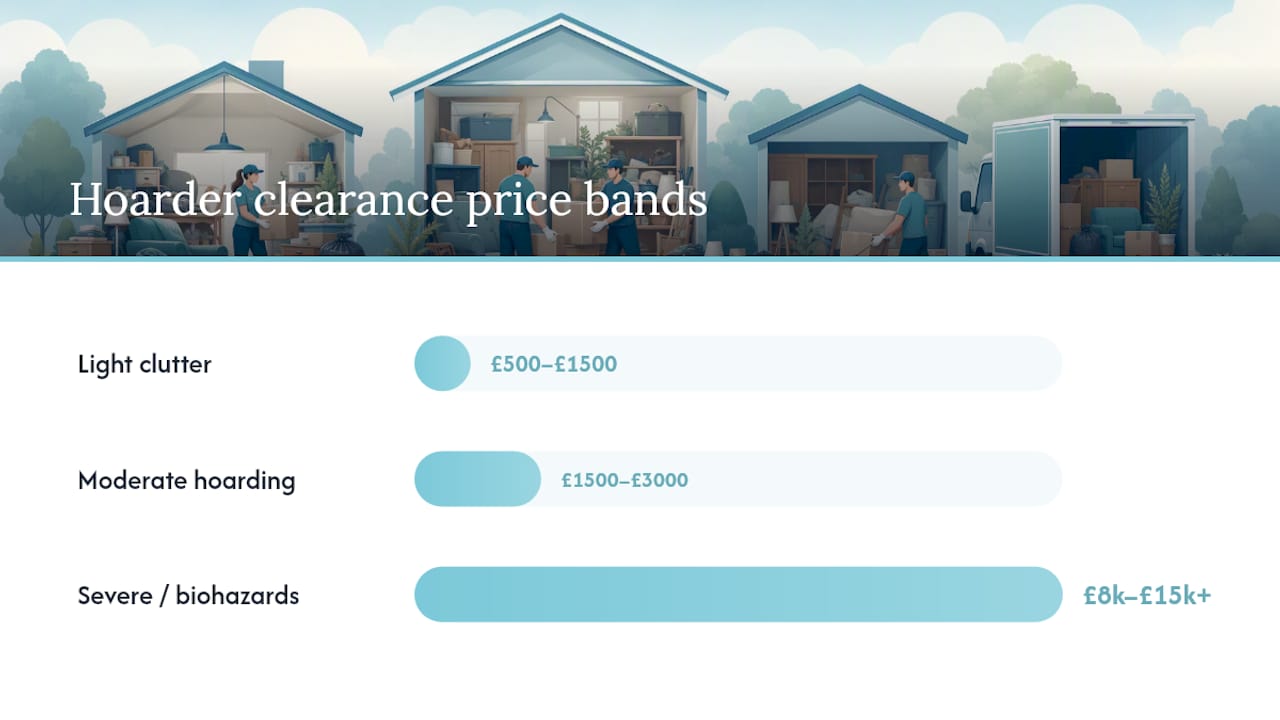
UK Biohazard Blog’s current price breakdown separates hoarder clearance into three clear bands, and those bands reflect what most reputable firms actually quote. Light clutter jobs sit at £500–£1,500. Moderate hoarding, where rooms are inaccessible and multiple van loads are needed, runs £1,500–£3,000. Severe or extreme cases, including whole-house clearances with contamination, typically cost £3,000–£10,000 or more.
To make those figures concrete, consider three realistic scenarios.
Scenario A: One-bedroom flat, light clutter. Two cleaners, one Luton van load, four to six hours on site. Core costs: labour roughly £144–£216 (two people at approximately £72 per person per day), van load disposal around £300, plus the firm’s margin. Total: likely £500–£900.

Scenario B: Three-bedroom semi, moderate hoarding. Three to four cleaners, two to three Luton van loads, one to two days on site. Labour, transport, and disposal combined typically reach £1,500–£3,000, rising if stairs or difficult access add time.
Scenario C: Four-bedroom detached, severe whole-house clearance with mould and vermin. A team of four to six over several days, multiple large Luton loads, specialist decontamination, and licensed hazardous waste disposal. This is where costs for most homes generally fall within the £4,000–£8,000 range, but can reach £15,000 or beyond in cases with extensive contamination.
Severity band | Typical UK cost | Usual inclusions |
Light clutter | £500–£1,500 | 1 van load, 2 cleaners, basic disposal |
Moderate hoarding | £1,500–£3,000 | 2–3 van loads, 3–4 cleaners, WTRs |
Severe / extreme | £4,000–£8,000 | Multiple loads, specialist team, decontamination |
Whole-house with biohazards | £8,000–£15,000+ | Licensed hazardous disposal, certified decontamination, full documentation |
How do clearance companies usually charge?
Most hoarder clearance firms use one of three pricing models, and knowing which one you are being quoted on is the only way to compare providers fairly.
Per van load. The company charges a set rate for each Luton van filled and removed. A small Luton van load costs around £341, while a large Luton van load runs approximately £1,012, according to Konnect You’s cost analysis. A hoarder clearance commonly requires three to eight or more loads, so this model can produce significant variation between quotes if firms define “van load” differently.
Flat project fee. Many specialist firms price the whole job after a site visit, covering labour, transport, and disposal in a single figure. UK Biohazard Blog notes that jobs are often priced per project rather than hourly, which gives families a clearer budget ceiling but makes it harder to see what is driving the price.
Day rate or hourly. Some firms charge per person per day (around £72 per person in published examples) plus disposal separately. This model suits staged clearances where the scope is uncertain.
Itemised extras sit on top of any base model: stair carries, difficult access, specialist waste handling, and additional crew all appear as line items on a thorough quote.
Van load pricing: ask the firm to state the van size and confirm the number of loads estimated.
Flat fee: request a breakdown showing labour, transport, and disposal as separate figures even within the flat total.
Day rate: confirm whether disposal is included or billed separately.
Pro Tip: When comparing quotes, ask every firm to express their price in van-load equivalents and itemised labour hours. A quote that bundles everything into one number is almost impossible to compare fairly against one that separates the components.
What makes hoarder clearances much more expensive?
Volume is the primary driver. Every additional Luton van load adds roughly £300–£1,000 in disposal costs alone, before labour is counted. A property with ten van loads of waste costs dramatically more than one with three, even if the hourly rate is identical.
Access and stair carries add time and therefore cost. A ground-floor flat clears faster than a three-storey Victorian terrace where every item must be carried down narrow stairs. Firms typically add a surcharge for stair carries or factor extra crew hours into the quote.
Pests, mould, and biohazards are where costs can multiply most severely. Konnect You warns that infestations, structural damage, or deep cleaning needs can triple the base clearance cost. A clearance that would otherwise cost £4,000 can reach £12,000 or more when vermin nesting, black mould, or blood and body fluids require specialist handling and licensed disposal.
Cost multiplier alert: Pest infestation, uncontrolled mould, or biohazard contamination can triple the base hoarder house clearance cost. Budget for specialist remediation as a separate line item, not an afterthought.
Secondary drivers include location (travel and disposal costs are higher in some regions), peak-season labour availability (summer and post-bereavement periods see higher demand), storage of sentimental items the family wishes to keep, and the insurance and DBS check requirements that reputable firms carry.
Pro Tip: Before the site visit, photograph every room and note any visible mould, pest activity, or water damage. Sharing this with the firm in advance allows them to quote more accurately and avoids surprise cost revisions on the day.
How long does a hoarder clearance usually take?
Families often underestimate the time a clearance requires, which affects access arrangements, temporary accommodation, and the scheduling of follow-on work such as deep cleaning or repairs.
Light jobs with two cleaners typically complete in 4–6 hours. Moderate clearances with a team of three to four run one to two full working days. Severe whole-house clearances with a team of four to six can take several days to one to two weeks, particularly when staged to allow the family time to review items or when specialist decontamination must occur between clearance phases.
Severity | Team size | Typical duration |
Light clutter | 2 cleaners | 4–8 hours |
Moderate hoarding | 3–4 cleaners | 1–2 days |
Severe / extreme | 4–6 cleaners | 3–7 days |
Whole-house with contamination | 4–6 + specialists | 1–2 weeks |
No1DreamClean’s worked examples confirm these crew and time estimates for UK hoarder clearances. A single-day blitz with a large team costs more in daily labour but reduces the calendar time, which matters when a property must be vacated or sold quickly. Staged clearances spread the cost across multiple visits but allow more careful sorting of possessions.
What happens to the waste, and what are your legal responsibilities?
Waste from a hoarder clearance does not simply disappear when the van leaves. Under the Environmental Protection Act Section 34, the duty of care for waste rests with the person who produces it, which in practice means you as the householder retain legal exposure if the firm you hire disposes of waste unlawfully. Fly-tipping by a clearance company can result in enforcement action against the property owner.
A reputable firm will segregate waste on site (recyclables, general waste, hazardous materials), transfer it only to authorised facilities, and provide a Waste Transfer Record for each load. Hazardous items such as asbestos, clinical waste, or certain chemicals require specialist licensed handling and cannot go to a standard transfer station.
Documents and trust signals to request before signing any contract:
Written, itemised quote separating labour, van loads, and disposal costs.
Copies of the firm’s Waste Carrier Registration (check against the Environment Agency public register).
Waste Transfer Records for every load removed from the property.
Public liability insurance certificate (minimum £1 million cover is standard; specialist firms often carry £5 million).
DBS checks for crew members entering a vulnerable person’s home, where relevant.
Before-and-after photographs and client references on request.
Certified disinfection or decontamination paperwork where biohazard cleaning is carried out.
Pro Tip: You can verify any firm’s Waste Carrier Registration for free on the Environment Agency’s public register at gov.uk. A firm that cannot or will not provide their registration number is a firm to avoid.
How to get accurate quotes and spot red flags
Getting three comparable quotes is the standard advice, but it only works if those quotes are structured the same way. A flat fee of £2,500 and an itemised quote of £2,800 are not directly comparable until you know what each includes.
Step-by-step checklist for requesting quotes:
Contact at least three firms and request an in-person site visit before any price is given. Refuse any firm that quotes without seeing the property.
Ask each firm to provide a written, itemised quote separating labour (hours and rate), number and size of van loads, disposal costs, and any specialist service charges.
Request the firm’s Waste Carrier Registration number and confirm it on the Environment Agency register.
Ask for copies of their public liability insurance certificate and, where relevant, DBS check confirmation for crew.
Confirm the scope in writing: which rooms, which items, and what the firm will and will not remove.
Ask for a realistic timeline and the number of crew members assigned.
Request references or before-and-after photographs from comparable previous jobs.
Red flags to watch for:
A low flat fee quoted over the phone or online without a site visit.
Refusal to supply Waste Transfer Records or Waste Carrier Registration details.
No written scope or timeline, only a verbal agreement.
Requests for large cash-only payments upfront.
No public liability insurance, or a certificate that cannot be verified.
Vague descriptions of where waste will be taken.
When comparing quotes, convert everything to van-load equivalents and itemised labour hours. Checkatrade’s house clearance cost guide reinforces that a transparent, itemised quote is the clearest indicator of a reputable firm and the most reliable basis for comparison.
When do you need a specialist decontamination or biohazard team?
Standard clearance firms are not trained or equipped for every situation a hoarder property presents. There are specific triggers that require a specialist team with hospital-grade decontamination capability, licensed waste handling, and documented protocols.

Red-line triggers for specialist involvement:
Trigger | Why specialist handling is required |
Vermin infestation (active or historic) | Rodent droppings carry hantavirus and leptospirosis; nesting material requires licensed disposal |
Blood, body fluids, or decomposition | Biohazard classification; requires PPE, licensed disposal, and certified decontamination |
Uncontrolled mould covering large areas | Structural penetration risk; spores require containment and specialist remediation |
Structural damage (floors, joists, ceilings) | Safety risk during clearance; requires structural assessment before work begins |
Clinical waste or sharps | Licensed clinical waste contractor required; cannot go to standard transfer stations |
Large-scale contamination | Documented chain of custody for waste is legally required |
Certifications and trust signals to expect from a specialist firm include: Waste Carrier Registration, documented WTRs for every load, public liability insurance, certified disinfection protocols with before-and-after documentation, and crew trained in the use of appropriate PPE.
Before a specialist site visit, record the following to help the team assess the job accurately:
Approximate number of rooms affected and the severity of accumulation in each.
Any visible mould, water damage, or structural concerns.
Evidence of pests (droppings, nesting, live activity).
Whether any deceased person was found in the property (relevant for trauma and after-death cleaning protocols).
Access constraints: narrow stairs, no lift, parking restrictions.
Dudleyspecialistcleaners provides hospital-grade decontamination and hoarder house clearance across Dudley, Wolverhampton, and Walsall, with full documentation and certified disposal for biohazard cases.
Pro Tip: If you are unsure whether your property crosses the threshold for specialist involvement, describe the triggers above to any firm you contact. A reputable specialist will tell you honestly whether standard clearance is sufficient or whether decontamination is required.
How families can reduce the bill safely
There are practical steps you can take before the clearance team arrives that genuinely reduce the time on site and therefore the cost. There are also tasks you should never attempt yourself.
Safe tasks for householders:
Clear unaffected rooms of personal items and valuables before the team arrives, reducing the area they need to work through.
Compile documents: tenancy agreements, utility bills, insurance policies, and any items with sentimental or financial value should be gathered and set aside.
Label or photograph items you want kept, donated, or sold, so the team does not need to pause and consult you on every decision.
Contact local charities or furniture reuse schemes in advance; some will collect directly from the property, reducing van loads.
Stage the clearance where possible: clearing one floor or one room type at a time reduces repeated van journeys.
Tasks to avoid entirely:
Handling any material that may be a biohazard (rodent droppings, blood, body fluids, mould-covered items).
Attempting mould removal without specialist PPE and containment.
Moving or disturbing suspected asbestos-containing materials.
Disposing of waste yourself without a registered waste carrier, which creates legal liability.
A brief safety note: if you do enter a hoarder property before the clearance team arrives, wear gloves and a dust mask as a minimum. If there is any sign of vermin activity or visible mould, leave the area and wait for the specialist team. Tetanus vaccination is worth confirming up to date if you will be handling old materials, particularly in properties with animal waste or soil contamination.
What to do with personal and sensitive items found during clearance
Hoarder clearances frequently surface items of significant personal, financial, or legal importance: original documents, jewellery, cash, medication, photographs, and sometimes items belonging to third parties. Having a clear plan for these before the team starts protects both the family and the clearance firm.
Before clearance begins, designate a single secure area (a locked room, a car boot, or a trusted person’s home) where sensitive items will be placed as they are found. Brief the clearance team on this arrangement so they know to pause and flag anything that looks significant rather than bag it with general waste.
Documents such as passports, birth certificates, bank statements, and wills should be handed directly to the family or their solicitor. Medication must be disposed of correctly: pharmacies accept unwanted medicines, and some clinical waste contractors handle larger quantities. Cash found on site should be counted and recorded in the presence of a witness.
For items of uncertain value, a brief assessment by a local auctioneer or valuer before the clearance begins can prevent accidental disposal of genuinely valuable pieces. Many clearance firms will flag items they believe have resale value, but this is not guaranteed, and the responsibility ultimately rests with the family.
Photographs and personal correspondence deserve particular care. Even where the volume of paper is large, a quick sort into “keep” and “shred” piles before the team bags general waste takes little time and prevents irreplaceable memories from being lost.
When should you book a clearance service?
Timing affects both cost and availability, and families who plan ahead consistently get better outcomes than those who need an urgent clearance.
Book as early as possible. Reputable specialist firms in the West Midlands and across the UK carry waiting lists, particularly in summer and in the weeks following a bereavement. Booking four to eight weeks ahead gives you time to gather quotes, verify credentials, and prepare the property.
Budget before you book. Use the cost bands in this guide to set a realistic ceiling, then add 20–25% as a contingency for specialist services that only become apparent on site. Families who budget only for the base clearance and then discover mould or pest activity face difficult decisions mid-job.
Avoid peak periods where possible. Post-bereavement clearances peak in spring and early autumn. If the clearance is not time-critical, scheduling for January to March or November often means better availability and, in some cases, more competitive pricing.
Coordinate with other professionals. If the property is being sold or re-let, align the clearance date with your estate agent or solicitor’s timeline. Deep cleaning, mould remediation, and any structural repairs need to follow the clearance, so build those lead times into your schedule from the start.
Clearway Recycling’s 2026 house clearance guide notes that property size and volume are the primary pricing determinants, which means an accurate site visit early in the process is the most reliable way to set a realistic budget and timeline.
Key takeaways
Hoarder house clearance in the UK costs £4,000–£8,000 for most standard homes, with severe whole-house clearances involving biohazards potentially reaching £15,000 or more. The single most important documents to request are Waste Transfer Records for every load removed.
Point | Details |
UK cost range | Most standard homes cost £4,000–£8,000; severe whole-house clears with biohazards can reach £15,000+. |
Leading cost drivers | Volume of waste, number of van loads, pest or mould presence, and difficult access are the biggest price movers. |
Top three red flags | No site visit before quoting, refusal to supply Waste Transfer Records, and cash-only payment demands. |
Three immediate next steps | Get three itemised quotes, verify each firm’s Waste Carrier Registration, and book a specialist if biohazard triggers are present. |
Dudleyspecialistcleaners | Provides hospital-grade hoarder clearance with certified decontamination, full WTR documentation, and itemised quotes across Dudley, Wolverhampton, and Walsall. |
The part of hoarder clearance that most guides miss
There is a tendency in cost guides to treat hoarder clearance as a logistics problem: count the rooms, estimate the van loads, multiply by a rate. That framing misses the most important variable, which is the human situation the clearance is happening inside.
Families who contact us are rarely in a straightforward position. They are often dealing with a bereavement, a safeguarding concern, or years of difficult family dynamics alongside the practical task of clearing a property. The cost of the clearance matters enormously to them, but so does the way the work is carried out: whether the team is discreet, whether sentimental items are treated with care, whether the documentation is handled correctly so there are no legal complications later.
What I have seen repeatedly is that families who invest in a specialist firm with proper credentials, clear documentation, and a compassionate approach spend less in the long run. They avoid the cost of remediation work that a cheaper firm missed, the legal exposure from unlicensed waste disposal, and the emotional cost of a clearance handled without sensitivity. The cheapest quote is rarely the best value when the property has any degree of contamination or the family situation is complex.
The right question to ask is not “what is the lowest price?” but “what does this firm actually include, and can they prove it?”
Dudleyspecialistcleaners: request a free site visit and quote
When a hoarder clearance involves mould, vermin, biohazards, or simply a property that has been accumulating for years, the difference between a general clearance firm and a specialist team shows up in the documentation, the decontamination, and the outcome.

Dudleyspecialistcleaners offers hoarder house clearance services across Dudley, Wolverhampton, and Walsall, combining hospital-grade decontamination with compassionate, discreet handling of every clearance. Every job includes an itemised written quote, Waste Transfer Records for each load, Waste Carrier Registration, and public liability insurance as standard. Where mould remediation is required, our mould removal service is integrated into the clearance plan rather than treated as a separate afterthought. Before-and-after photographs and certified disinfection paperwork are provided on request.
To get a realistic, no-obligation cost for your property, contact us to arrange a free site visit. We will assess the severity, identify any specialist requirements, and provide a clear written quote with no hidden charges.
Useful sources
The following sources informed this guide and are worth consulting for further detail.
Recommended
Comments