Care home infection control: your complete action guide
Updated: Oct 8
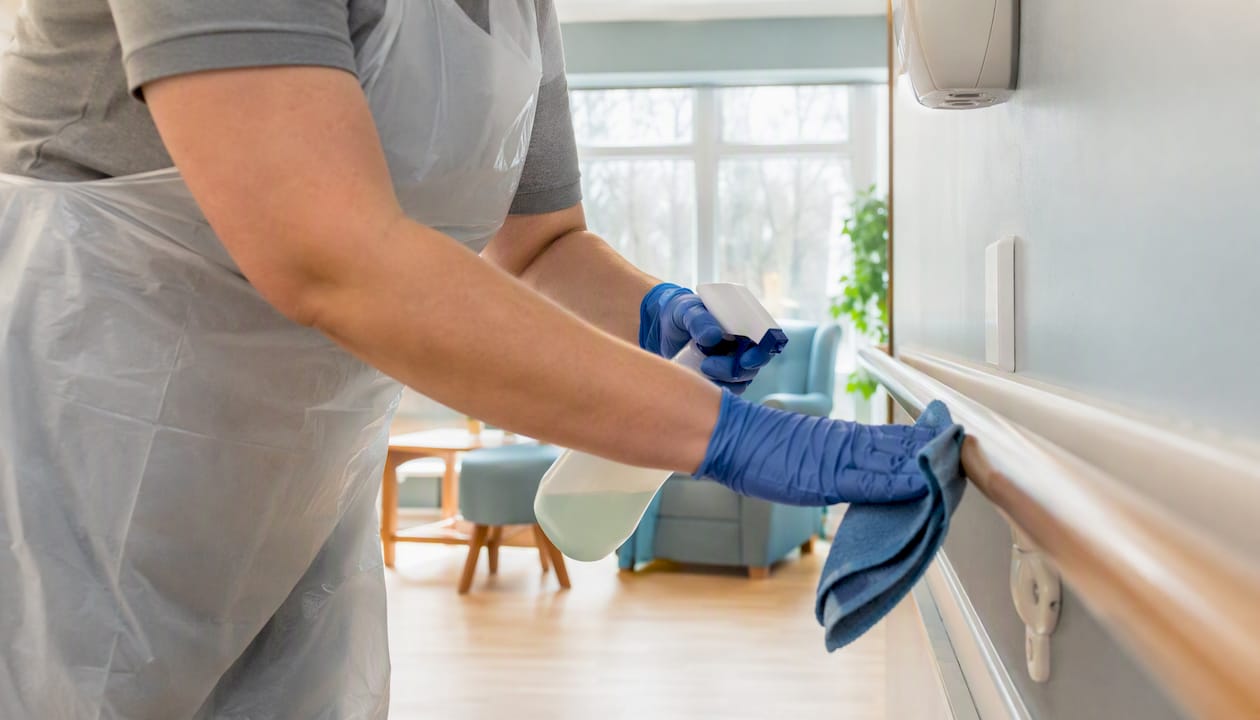
Take eight immediate actions now to reduce transmission risk in your care home, and you will have addressed the most common gaps inspectors find under CQC Key Line of Enquiry S5.
Enforce hand hygiene at every care interaction. Hand hygiene remains the single most effective measure for breaking transmission chains. Post technique reminders at every sink and alcohol-based rub dispenser.
Isolate any symptomatic resident immediately. Place them in a single room with en-suite facilities where possible, and apply contact and droplet precautions before you have a confirmed diagnosis.
Apply all ten Standard Infection Control Precautions (SICPs). SICPs are continuous, not outbreak-only. The Care Home Infection Prevention and Control Manual (CH IPCM) sets these out as the baseline for every care interaction.
Assess whether Transmission-Based Precautions (TBPs) are needed. If SICPs alone are insufficient, escalate to contact, droplet, or airborne precautions as the clinical picture warrants.
Increase cleaning frequency on high-touch surfaces. Door handles, call bells, handrails, and shared equipment should be cleaned and disinfected frequently during any period of elevated risk.
Check PPE stocks and donning/doffing practice. Confirm you have adequate gloves, aprons, fluid-resistant surgical masks, and eye protection, and that every staff member can demonstrate correct technique.
Notify your local Infection Prevention and Control Team (IPCT) or Health Protection Team (HPT) if red-flag criteria are met. Two or more linked cases of respiratory illness within five days is a recognised trigger for escalation under ARI outbreak guidance.
Document the event from the outset. Record the date and time of first symptom, the risk assessment completed, actions taken, and who was notified. This record is your audit trail for CQC and the HPT.
The Health and Social Care Act 2008 code of practice requires registered providers to have systems in place to manage and monitor infection prevention and control. The eight actions above are where that system starts.
Key takeaways
Effective care home infection control rests on applying SICPs consistently every day, escalating to TBPs and specialist support when the situation demands it, and maintaining the documentation that proves your system is working.
Point | Details |
SICPs are the daily baseline | Apply all ten Standard Infection Control Precautions to every resident in every interaction, not only during outbreaks. |
Two linked cases trigger escalation | Two or more linked respiratory cases within five days is the recognised trigger to notify your local IPCT or HPT and implement TBPs. |
Deep cleaning requires validation | Physical removal with detergent precedes disinfection; retain product records, cleaning logs, and ATP results as audit evidence. |
MDRO admission is usually safe | GOV.UK guidance confirms admission or readmission with MDRO carriage is usually appropriate when decisions are risk-assessed and IPC measures are documented. |
Dudleyspecialistcleaners provides certified decontamination | For biohazard, post-death, or large-scale contamination in Dudley, Wolverhampton, and Walsall, Dudleyspecialistcleaners delivers validated cleaning with full documentation for inspection purposes. |
Table of Contents
Standard infection control precautions: the ten core measures in practice
Transmission-based precautions: when to escalate beyond the daily standard
Admissions, screening, and resident placement: a safer workflow
Environmental cleaning and decontamination: routine, enhanced, and deep-clean workflows
PPE in care homes: task-based selection, donning, doffing, and RPE
Recognising and managing an outbreak: stepwise actions and notifications
Managing MDROs and antimicrobial stewardship in your care home
Managing visitors: screening, compassionate visiting, and residents’ rights
How Dudleyspecialistcleaners supports care homes in Dudley, Wolverhampton, and Walsall
What CQC inspectors look for under KLOE S5
Care Quality Commission inspectors assess infection prevention in care homes through Key Line of Enquiry S5: “How well are people protected by the prevention and control of infection?” The structured information-gathering tool they use covers six main areas, and understanding each one lets you self-assess before an inspection arrives.
The six S5 focus areas:
Visitor safety — whether all visitors are prevented from catching and spreading infection, and whether visiting is enabled wherever possible using national guidance and local HPT advice.
Safe use of the environment and premises cleanliness — whether communal areas, bedrooms, bathrooms, and equipment are visibly clean and maintained to an appropriate standard.
Admissions — whether the home has a process for assessing infection risk before and at the point of admission, including screening for symptoms and MDRO history.
PPE use — whether staff select, don, and doff PPE correctly for each task and whether adequate stocks are maintained.
Staff training — whether all staff, including bank and agency workers, have received IPC training appropriate to their role and whether competency has been assessed.
Outbreak response — whether the home has a documented outbreak plan, knows when to notify the HPT, and can demonstrate it has acted on previous outbreaks.
Inspectors use three assurance ratings: assured, somewhat assured, and not assured. Moving an item from “not assured” to “assured” usually requires two things: a current, followed policy and a contemporaneous record proving it was followed.
Evidence items inspectors expect to see:
An up-to-date IPC policy, reviewed within the last twelve months and signed off by the registered manager.
Staff IPC training records, including induction training for new starters and annual refresher records for all staff.
Audit logs showing regular hand hygiene, environmental cleaning, and PPE audits with actions taken where gaps were found.
IPC admission risk assessments, completed for each admission and retained on file.
Cleaning schedules with completion signatures, covering both routine and enhanced cleaning.
PPE inventory records showing stock levels are monitored and replenished.
A documented outbreak management plan and records of any previous outbreak responses.
Pro Tip: Before your next inspection, pull three recent admission records and check whether each one contains a completed IPC risk assessment. If any are missing, that gap will appear under S5 admissions. Completing a retrospective audit and corrective action log before the inspection demonstrates a responsive system, which inspectors view more favourably than a silent gap.
Standard infection control precautions: the ten core measures in practice
The CH IPCM defines SICPs as the baseline precautions applied to every resident, in every care interaction, regardless of known infection status. They are not outbreak measures. They are the daily standard.
Resident placement. Assess each resident’s risk of transmitting or acquiring infection and place them accordingly. A single room with en-suite facilities is preferable for any resident with a known or suspected transmissible condition. In communal areas, maintain adequate spacing and ventilate regularly.
Hand hygiene. Use soap and water for visibly soiled hands and after contact with body fluids. Use alcohol-based hand rub at the five WHO moments: before touching a resident, before a clean or aseptic procedure, after body fluid exposure risk, after touching a resident, and after touching a resident’s surroundings. Observable checkpoint: staff should not be wearing wrist jewellery or nail extensions during care.
Respiratory hygiene. Encourage residents and staff to cover coughs and sneezes with a tissue, dispose of it immediately, and perform hand hygiene. Provide tissues and bins at reception, in communal areas, and in each bedroom. Post clear signage.
PPE. Select PPE based on the task and the assessed risk, not habit. Gloves and aprons are minimum for personal care; fluid-resistant surgical masks and eye protection are added for care of a resident with suspected respiratory infection. Don before entering the care zone; doff immediately after and perform hand hygiene. PPE is the last level in the hierarchy of controls and must be complemented by environmental and organisational measures.
Safe management of reusable shared care equipment. Clean and decontaminate shared equipment between each resident use. Record decontamination of items such as hoists, commodes, blood pressure cuffs, and pulse oximeters. Single-use items must never be reprocessed.
Safe management of the care environment. Maintain a cleaning schedule that covers all areas, including frequently overlooked surfaces such as light switches, remote controls, and bed rails. Increase frequency during periods of elevated risk.
Safe management of linen. Handle used linen with minimal agitation to avoid dispersing microorganisms. Bag at the point of use. Wash at the temperature and cycle recommended for the fabric type. Infected linen should be placed in a water-soluble bag before the outer bag.
Safe management of blood and body fluid spillages. Use a chlorine-based disinfectant at the appropriate concentration for the type of spillage. Apply PPE before approaching the spill. Remove bulk material first, then clean and disinfect. Dispose of all materials as clinical waste.
Safe waste disposal. Segregate waste at the point of generation: clinical waste in yellow or tiger-stripe bags, offensive waste in yellow-striped bags, domestic waste in black bags. Sharps go directly into an approved sharps container at the point of use. Never re-sheath needles.
Occupational safety. Report all sharps injuries, blood and body fluid exposures, and potential occupational exposures immediately. Maintain up-to-date vaccination records for all staff, including seasonal influenza and hepatitis B where indicated. Staff with symptoms of infection should not work in direct care roles.
Transmission-based precautions: when to escalate beyond the daily standard
TBPs are applied when SICPs alone are not sufficient to prevent transmission. The CH IPCM endorses an assess and escalate approach: if a resident’s clinical presentation suggests a route of transmission that SICPs do not fully address, you add the appropriate TBP without waiting for laboratory confirmation.
There are three TBP categories, each with distinct triggers and first-line actions:
Contact precautions are triggered by conditions spread through direct or indirect contact: MRSA, Clostridioides difficile (C. diff), norovirus, scabies, and wound infections with resistant organisms. First-line actions include placing the resident in a single room, using gloves and apron for all contact, dedicating equipment to that resident, and increasing environmental cleaning frequency. Visitors should be advised to perform hand hygiene on entry and exit.
Droplet precautions are triggered by respiratory infections spread via large droplets: influenza, respiratory syncytial virus (RSV), and similar conditions. Add a fluid-resistant surgical mask when within one metre of the resident. Limit movement of the resident outside their room where clinically safe to do so.
Airborne precautions are triggered by conditions spread via small airborne particles: suspected or confirmed tuberculosis (TB), measles, or varicella. These require a fit-tested FFP3 respirator (RPE) rather than a surgical mask. Where possible, the resident should be placed in a room with negative pressure ventilation or, at minimum, a room with a window that can be opened. After an aerosol-generating procedure (AGP), a fallow period is required before the room is re-entered: typically one hour in a naturally ventilated room and a shorter period in a mechanically ventilated room, depending on air changes per hour (ACH). Consult your local IPCT for the specific fallow time applicable to your room configuration.
The ARI guidance recommends combining SICPs with proportionate, time-limited TBPs and vaccination, and frames outbreak triggers to prompt immediate risk assessment rather than waiting for external direction.
Admissions, screening, and resident placement: a safer workflow
Every admission carries an infection risk in both directions: the incoming resident may introduce a pathogen, or they may be particularly vulnerable to one already circulating in the home. A short, structured screening process at the point of admission addresses both.
Pre-admission screening checklist:
Current symptoms of respiratory infection, diarrhoea, vomiting, or skin rash.
Recent exposure to a known infectious illness, including within the household or previous care setting.
Known MDRO carriage history (MRSA, ESBL, CPE, or similar).
Vaccination status, including influenza, COVID-19, and pneumococcal.
Capacity and ability to comply with IPC measures such as hand hygiene and staying in their room during isolation.
Recent antibiotic use, which may increase C. diff risk.
Placement decisions based on screening:
Admit as usual if no risk factors are identified and the home is not in an active outbreak. Document the completed risk assessment and the rationale.
Admit to a single room with enhanced precautions if the resident has known MDRO carriage, recent symptoms, or has come from a setting with an active outbreak. GOV.UK MDRO guidance confirms it is usually safe to admit or readmit people with MDRO carriage provided risk-assessed IPC measures are in place.
Defer admission and seek IPCT advice if the resident has active symptoms of a highly transmissible condition and a single room is not available, or if the home is already managing an outbreak.
Record-keeping prompts for each admission decision:
Name of the person who completed the risk assessment and their role.
Date and time of assessment.
Risk factors identified (or confirmed absent).
Placement decision and rationale.
Mitigation measures applied (e.g., single room, enhanced cleaning, PPE requirements for staff).
Date of review if the resident is placed in temporary isolation.
The CH IPCM notes that admission screening should include a documented assessment of the resident’s capacity and ability to comply with IPC measures, keeping decisions both auditable and resident-centred.
Environmental cleaning and decontamination: routine, enhanced, and deep-clean workflows
Cleaning is not a housekeeping function. It is an infection control intervention, and the frequency, method, and product choice all affect its effectiveness.
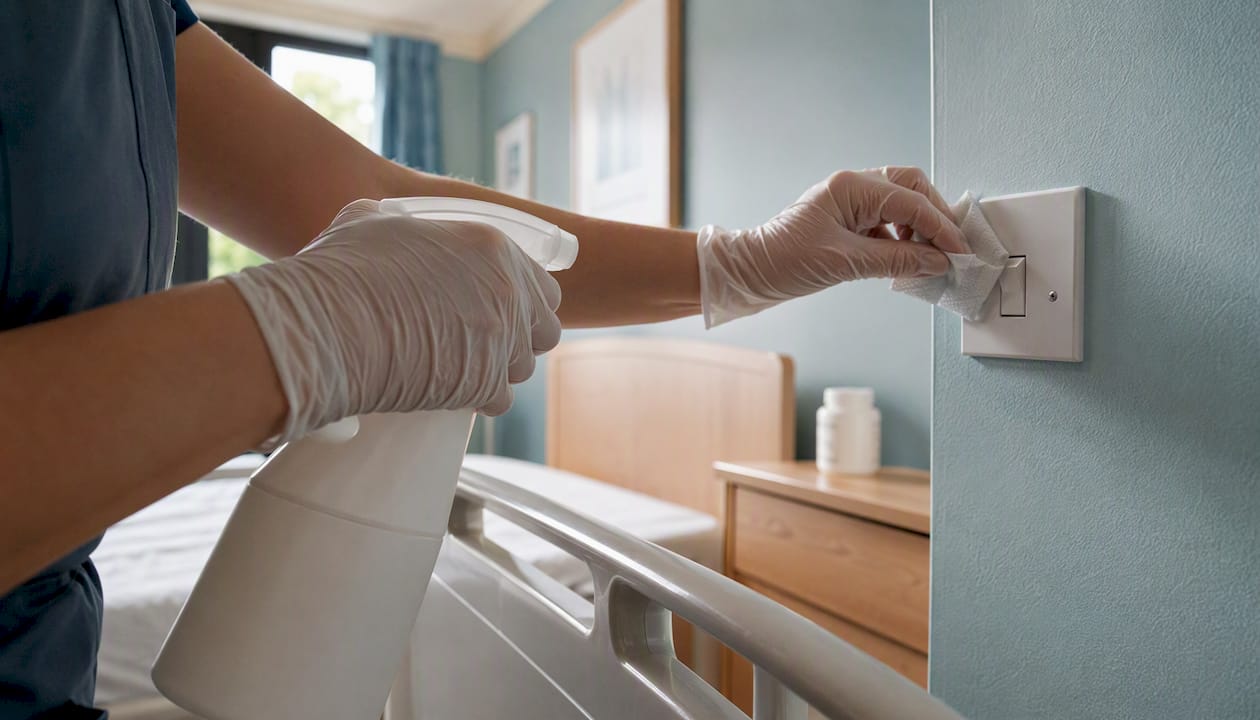
Routine daily cleaning covers all resident rooms, communal areas, bathrooms, and kitchens. High-touch surfaces — door handles, light switches, call bells, handrails, toilet flush handles, and shared equipment — should be cleaned at least twice daily as a minimum, and more frequently during any period of elevated risk. Use a neutral detergent solution for routine cleaning; add a disinfectant only where clinically indicated or directed by your IPCT.
Enhanced cleaning is applied during an outbreak or following a confirmed case in a specific area. Increase the frequency of high-touch surface cleaning to every two to four hours, add a disinfectant appropriate to the organism, and document each cleaning episode with the time, operative’s name, and product used.
Deep-clean workflow (stepwise):
Don appropriate PPE: disposable gloves, apron, and eye protection as a minimum. If the area is heavily contaminated or an AGP has occurred, consult your IPCT regarding RPE requirements.
Remove all removable items from the area and clean them separately.
Apply hot water and neutral detergent first to achieve physical removal of organic matter. NHS deep-clean guidance is clear that physical removal precedes disinfection.
Work from the cleanest areas to the dirtiest, and from top to bottom: ceiling fittings, walls, furniture surfaces, then floor.
Change cleaning solution and cloths when moving between rooms or when visibly contaminated. Colour-coded disposable cloths prevent cross-contamination between areas: typically red for bathrooms and toilets, blue for general areas, yellow for isolation rooms.
Apply disinfectant at the concentration recommended by your IPCT for the specific organism involved. Allow the correct contact time before wiping.
Dispose of all used cloths, gloves, and aprons as clinical waste. Wash hands thoroughly.
Document the deep clean: date, time, operative, products used, areas covered, and any validation steps completed.
Product selection rules: detergent removes organic matter; disinfectant kills microorganisms. Using disinfectant on a visibly soiled surface without cleaning first reduces its effectiveness significantly. Consult your local IPCT before selecting a disinfectant product, particularly for resistant organisms such as C. diff, which requires a chlorine-based product at the correct concentration.
Pro Tip: After any deep clean, retain the product data sheets, the cleaning record, and, where available, ATP swab results as validation evidence. CQC inspectors and HPTs may ask to see proof that a deep clean was completed and validated, not just that it was scheduled.
When to call a specialist decontamination contractor
Most care homes can manage routine and enhanced cleaning in-house with trained staff. There are situations, however, where the scale, nature, or regulatory complexity of the contamination requires a specialist contractor.
Red-flag criteria for external escalation:
Large-scale bodily fluid contamination beyond the capacity of in-house cleaning staff to manage safely.
Biohazard scenes including after-death cleaning, trauma, or significant blood contamination.
Repeated outbreaks despite documented in-house controls, suggesting environmental reservoirs that routine cleaning has not cleared.
Post-AGP terminal decontamination where room ventilation is uncertain and fallow-time compliance cannot be verified.
Legal or forensic scenes where chain-of-custody documentation is required.
Mould contamination affecting resident rooms or communal areas, which carries both respiratory and infection risk for vulnerable residents.
What a legitimate contractor should provide:
A written risk assessment specific to your site and the contamination type.
A method statement describing the process, products, and PPE to be used.
Evidence of staff training and competency in the relevant decontamination methods.
Waste carrier registration and documentation for the disposal of clinical or hazardous waste.
A scope of work agreed before commencement.
A validation report on completion, confirming the area has been decontaminated to the required standard.
Due-diligence questions to ask prospective contractors:
Are you registered as a waste carrier with the Environment Agency?
Can you provide a sample method statement and validation report from a comparable job?
What insurance do you hold, and does it cover biohazard and clinical waste removal?
Have you worked in CQC-regulated care settings before, and can you provide references?
How do you document and certify the decontamination process for inspection purposes?
Pro Tip: Retain every document the contractor provides: the risk assessment, method statement, waste transfer notes, and validation report. File them with your IPC records. If CQC or the HPT asks how a contamination event was managed, this paperwork is your evidence of a proportionate, professional response.
PPE in care homes: task-based selection, donning, doffing, and RPE
PPE is the last line of defence in the hierarchy of controls, not the first. It works only when the right item is selected for the task, worn correctly throughout, and removed without self-contamination.
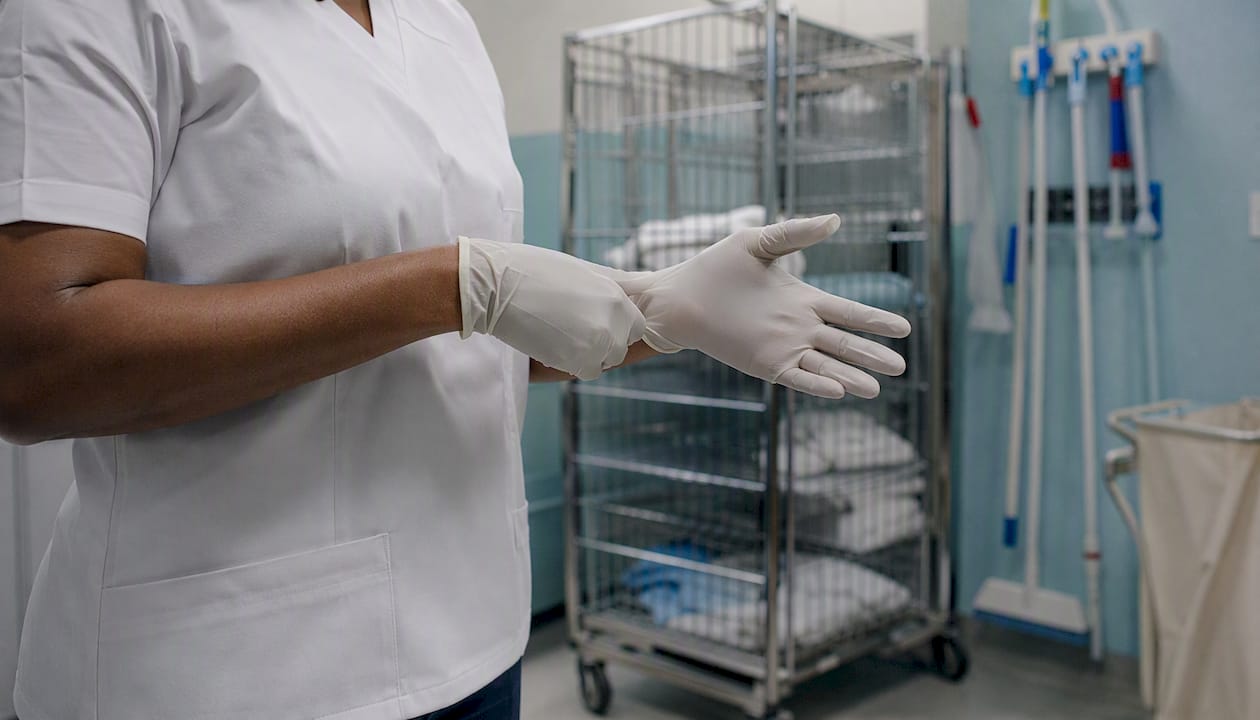
Task-based PPE selection:
FRSM = fluid-resistant surgical mask
Donning order:
Perform hand hygiene.
Put on apron.
Put on gloves.
Put on FRSM or FFP3 (if required).
Put on eye protection (if required).
Doffing order (most contaminated items first):
Remove gloves (peel off without touching the outer surface).
Perform hand hygiene.
Remove apron (roll inward, away from body).
Perform hand hygiene.
Remove eye protection (handle by the arms or headband).
Perform hand hygiene.
Remove FRSM or FFP3 (handle by the ties or headbands, not the front).
Perform hand hygiene.
RPE and fit-testing: An FFP3 respirator must be fit-tested to the individual wearer before use. Fit testing is not a one-off event: it should be repeated if the wearer’s face shape changes significantly (weight change, dental work, scarring). Keep a fit-test record for each member of staff, noting the make, model, and size of respirator tested and the date. Conduct daily stock checks to confirm adequate RPE is available before shifts begin.
Staff training, IPC roles, audits, and record-keeping
A care home’s IPC system is only as strong as the people running it. Assigning clear roles, training to a documented standard, and auditing regularly are what turn a policy into a practice.
Core IPC roles:
Nominated IPC lead (usually the registered manager or a senior nurse): responsible for maintaining the IPC policy, reviewing it annually, liaising with the local IPCT, and overseeing audit outcomes. Must record all policy reviews, IPCT contacts, and audit results.
Shift-level IPC champion (a senior care worker or nurse on each shift): responsible for monitoring hand hygiene and PPE compliance during their shift, escalating concerns to the IPC lead, and completing shift-level cleaning checks.
Cleaning lead: responsible for maintaining cleaning schedules, ensuring colour-coded consumables are used correctly, and documenting each cleaning episode.
Training plan template:
Induction: all new staff complete IPC induction training before working unsupervised. Topics include hand hygiene technique, PPE selection and use, waste segregation, and the home’s outbreak management plan.
Annual refresher: all staff, including bank and agency workers, complete an annual IPC refresher. Document completion and the assessment outcome.
Competency assessment: observe each member of staff performing hand hygiene and PPE donning/doffing at least annually. Record the observation, the outcome, and any corrective action taken.
Audit checkpoints:
Hand hygiene compliance: observe and record at least monthly.
PPE use: observe and record at least monthly.
Environmental cleaning: review cleaning schedules for completion gaps weekly.
Equipment decontamination: check records for commodes, hoists, and shared equipment monthly.
Record retention: retain IPC training records, audit logs, outbreak records, and admission risk assessments for a minimum of three years, or longer if local policy requires. The H&SCA code of practice requires registered providers to have systems to manage and monitor IPC, and records are the evidence that those systems are functioning.
Recognising and managing an outbreak: stepwise actions and notifications
An outbreak in a care home is defined, for acute respiratory infections, as two or more linked cases within five days. That trigger should prompt immediate action, not a wait for external confirmation.
Immediate actions on suspecting an outbreak:
Isolate symptomatic residents in single rooms and apply appropriate TBPs.
Implement enhanced cleaning across the affected area, increasing high-touch surface frequency to every two to four hours.
Review staffing rotas: symptomatic staff must not work. Consider whether staff who have worked across multiple areas may have contributed to spread.
Restrict new admissions to the affected area or the whole home, depending on the scale of spread, pending IPCT advice.
Convene a brief daily huddle with the IPC lead, cleaning lead, and senior care staff to review case numbers and control measures.
Notification triggers and who to contact:
Contact your local IPCT or HPT as soon as you suspect an outbreak. Do not wait for laboratory confirmation.
The HPT will typically ask for: the number of cases (residents and staff), symptom onset dates, the area of the home affected, current control measures in place, and vaccination status of affected individuals.
For notifiable diseases (including certain strains of influenza and food-borne illness), notification to the local authority proper officer is a legal requirement.
Communication talking points:
For staff: “We have identified a possible outbreak of [condition] in [area]. We are applying enhanced precautions. Please follow the updated PPE and cleaning guidance and report any symptoms immediately.”
For residents: “We are taking extra precautions at the moment to keep everyone safe. We will keep you informed and will do everything we can to support you during this time.”
For families: “We want to keep you informed. We are managing a situation that may affect visiting. We will contact you individually if your relative is affected and will update you as the situation develops.”
For visiting professionals: “We currently have enhanced IPC precautions in place. Please speak to the nurse in charge before entering the home.”
Maintain a written log of all communications, including who was contacted, when, and what was said.
Managing MDROs and antimicrobial stewardship in your care home
Multi-drug-resistant organisms (MDROs) cause anxiety in care settings, but the evidence base is clear: blanket exclusion is not the answer. GOV.UK MDRO guidance states it is usually safe to admit or readmit people with current or previous MDRO carriage, provided decisions are risk-assessed and suitable IPC measures are applied.
The practical focus for MDRO management is hand hygiene, environmental cleaning, and targeted precautions rather than isolation as a default.
MDRO management checklist:
Complete an IPC risk assessment for every resident with known MDRO carriage at admission and review it regularly.
Prioritise hand hygiene with soap and water (preferred over alcohol-based rub for C. diff) at key moments.
Clean communal areas daily and high-touch surfaces in the resident’s room at increased frequency.
Dedicate equipment to the resident where possible, or decontaminate shared equipment between uses.
Educate the resident and their family about the MDRO, the precautions in place, and when to escalate concerns to the care team.
Contact your local IPCT if you are uncertain about the appropriate precaution level for a specific organism.
Antimicrobial stewardship (AMS) checklist:
Maintain a local AMS policy, reviewed annually, that references national guidance such as the NICE antimicrobial prescribing guidelines.
Document the clinical rationale for every antimicrobial prescribed to a resident, including the indication, organism (if known), and intended duration.
Prompt prescribers to review antimicrobial courses at 48–72 hours and to stop or de-escalate where clinically appropriate.
Link with your local antimicrobial pharmacist or IPCT for advice on empirical treatment choices.
Track antimicrobial use across the home and review patterns quarterly to identify any concerning trends.
Pro Tip: Residents with hearing aids require particular attention to device hygiene, as shared or poorly cleaned devices can act as fomites. Refer to guidance on cleaning hearing aids to support residents in maintaining their devices safely, and include personal device cleaning in your MDRO care plan where relevant.
Managing visitors: screening, compassionate visiting, and residents’ rights
Visitor policies must be proportionate. Restricting visiting beyond what the clinical situation requires causes real harm to residents’ wellbeing, and CQC inspectors will look for evidence that the home has enabled visits wherever possible.
Visitor screening checklist:
Ask all visitors whether they have current symptoms of respiratory infection, diarrhoea, or vomiting before entering.
During an active outbreak, provide visitors with information about the current situation and the precautions in place.
Offer hand hygiene facilities at the entrance and ask all visitors to use them.
Provide PPE to visitors where required by the current risk level, with brief verbal instruction on use.
Proportionate restrictions based on risk:
No active outbreak: open visiting with standard hygiene measures. No restriction on visitor numbers beyond the home’s normal policy.
Active outbreak in one area: restrict visiting to the affected area where possible. Enable visits to unaffected areas with enhanced hygiene measures.
Whole-home outbreak: consider time-limited restrictions on non-essential visiting, based on HPT advice. Document the decision, the rationale, and the HPT advice received.
Compassionate visiting principles:
End-of-life visits should be enabled in all but the most exceptional circumstances, with appropriate PPE provided and a risk assessment completed.
Make reasonable adjustments for residents with dementia or learning disabilities for whom visiting is particularly important to wellbeing.
Review visiting restrictions at least every 48 hours during an outbreak and lift them as soon as the clinical situation allows.
CQC guidance stresses enabling visits unless restricted by national guidance or HPT advice, and asks inspectors to assess whether all types of visitors are prevented from catching and spreading infection without unnecessary restriction.
Document every visiting decision: record the date, the risk level at the time, the decision made, the rationale, and any HPT advice that informed it. A documented, reviewed decision is defensible at inspection; an undocumented restriction is not.
Key national IPC resources to bookmark
Every care home manager should have these resources saved and accessible. They are the authoritative, regularly updated references for policy, inspection preparation, and operational decisions.
Care Home Infection Prevention and Control Manual (CH IPCM) — the primary practice guide for care home IPC in Scotland, covering SICPs, TBPs, admissions, outbreak management, and more. Updated online in real time. Consult first for any clinical IPC question.
ARHAI Scotland Care Home IPC Compendium — a collection of education, measurement, and implementation tools to use alongside the CH IPCM. Download and file the current version; check for updates periodically.
CQC infection prevention and control in care homes — the S5 inspection framework and information-gathering tool. Essential for inspection preparation and self-assessment. Updated as CQC methodology evolves.
Gov — consult first for any question about admissions, readmissions, or precautions for residents with MDRO carriage. England-focused.
Gov — the primary reference for outbreak triggers, notification requirements, and proportionate control measures. England-focused; Scottish homes should also consult the CH IPCM.
NHS deep-clean guidance for care homes — the stepwise deep-clean protocol referenced throughout this guide. Download and include in your cleaning policy.
H&SCA 2008 code of practice — the legal framework underpinning all IPC requirements for registered providers in England. The ten criteria set out here are what CQC uses to judge compliance.
Jurisdiction note: the CH IPCM and ARHAI compendium are Scottish resources; the GOV.UK guidance and H&SCA code apply to England. Managers in Wales and Northern Ireland should consult their respective public health agencies. All managers should contact their local IPCT or HPT for region-specific application of any national guidance.
What we see on site: a contractor’s perspective
Working in care homes across Dudley, Wolverhampton, and Walsall, we encounter a consistent pattern. The homes that manage infection risk most effectively are not necessarily the ones with the most elaborate policies. They are the ones where the basics are embedded in daily practice and where the manager knows, without hesitation, who to call when something is beyond in-house capacity.
The most common gap we find on site is not a missing policy. It is the absence of documented evidence that the policy was followed. A deep clean was carried out, but there is no record of the products used, the operative who did the work, or any validation that the area was decontaminated to the required standard. When the HPT or CQC asks, the home cannot demonstrate what happened.
The second most common issue is scope. In-house cleaning teams are trained for routine and enhanced cleaning. They are not always equipped, trained, or insured to manage large-scale biohazard contamination, post-death decontamination, or mould remediation in a way that meets regulatory expectations. Recognising that boundary and calling a specialist promptly is a sign of good governance, not a failure.
Pro Tip: After any contracted decontamination job, ask for the waste transfer note, the method statement, and the validation report before the contractor leaves site. These three documents are your proof of a compliant, professional response. File them with your IPC records immediately.
How Dudleyspecialistcleaners supports care homes in Dudley, Wolverhampton, and Walsall
When in-house cleaning reaches its limit, you need a contractor who understands the regulatory environment you work in, not just the cleaning process.
Dudleyspecialistcleaners provides hospital-grade disinfection and specialist decontamination services specifically for care settings in Dudley, Wolverhampton, and Walsall. Our services cover deep cleaning and validated disinfection, biohazard and bodily fluid clearance, mould remediation, after-death cleaning, and clinical waste handling, all with full documentation and certification on completion.
Every job begins with a written risk assessment and method statement. Our operatives are trained in appropriate PPE and decontamination protocols, and we provide a validation report at the end of each job so you have the audit evidence CQC and your HPT may request. We also handle waste disposal with full carrier registration, so the chain of documentation is complete from start to finish.
For care homes managing a contamination event, a repeated outbreak, or a post-death scenario, we offer prompt site assessments and clear, transparent quotes. Contact us through our main services page to arrange a local site assessment or to discuss your requirements with our team.
Sources
The sources below are the primary references for care home infection prevention and control in the UK. Consult your local IPCT or HPT to confirm how national guidance applies in your region.
Infection prevention and control in care homes - Care Quality Commission
Infection prevention and control for multidrug-resistant organisms in adult social care settings
Management of acute respiratory infection outbreaks in care homes
Health and Social Care Act 2008: code of practice on the prevention and control of infections
This article is general information, not a substitute for advice from a qualified doctor. Consult a qualified healthcare professional about your own circumstances before acting on anything here.
Recommended
Related Dudley services
For a booking, start with mould removal, after-death cleaning and house clearance. Call 07462 479 576 or 0800 193 3699.
Comments