NHS cleaning standards: a practical guide for H&S professionals
Updated: Oct 8
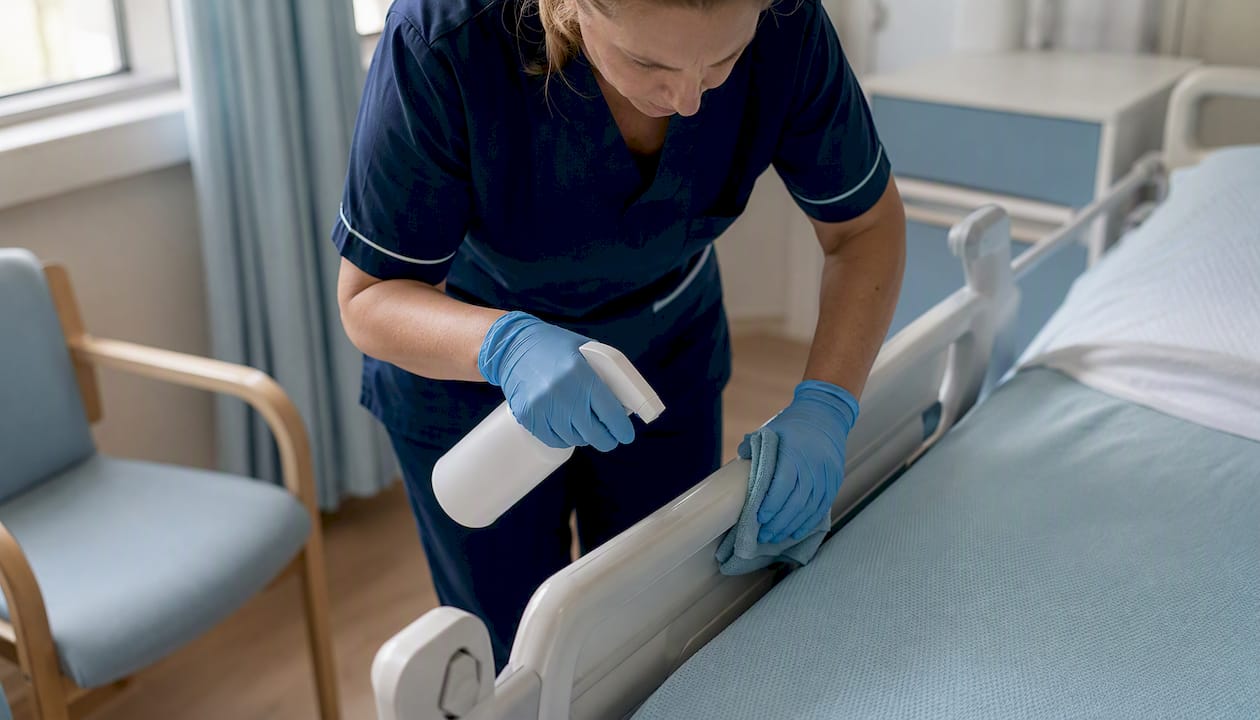
The National standards of healthcare cleanliness 2025 set outcome-based requirements across all NHS settings, establish six functional risk (FR) categories, and mandate a three-part audit regime covering technical, efficacy, and external audits, with results published as star ratings for public accountability. If you are starting compliance work today, your first three actions are clear.
Identify the FR category for every clinical and patient-facing area in your trust.
Confirm which audit schedule applies under your Facilities Monitoring Tool (FMT) or National Cleaning Services Specification (NCSS) mapping.
Sign or publicise the Commitment to Cleanliness Charter locally to establish cross-departmental ownership from the outset.
Pro Tip: Before scheduling any audit, verify that your FMT specification codes are correctly assigned to room types. Mismatched codes are the single most common reason trusts run audits at the wrong frequency, which creates compliance gaps that are difficult to explain to external auditors.
Key takeaways
The National standards of healthcare cleanliness 2025 require outcome-based compliance across all NHS settings, with risk-mapped audit frequencies, cross-departmental ownership, and publicly published star ratings as the core accountability mechanism.
Point | Details |
Map FR categories first | Assign functional risk categories to all clinical areas before setting any audit schedule. |
Run efficacy audits before technical | Process failures drive poor scores; fix the process before measuring the outcome. |
Audit periods range from two weeks to six months | Frequency is determined by risk category via FMT or NCSS specification codes. |
Cleaning is cross-departmental | Clinical teams own cleaning responsibilities in their zones; estates does not carry compliance alone. |
Dudleyspecialistcleaners supports rectification | Validated disinfection, documentation, and certification services are available for NHS facilities across Dudley, Wolverhampton, and Walsall. |
Table of Contents
What do the NHS cleaning standards actually require?
The 2025 standards are built around six design principles that shape how every trust, clinic, and ambulance service approaches cleanliness.
Easy to use: practical enough for frontline teams without specialist interpretation.
Freedom within a framework: trusts may shape local SOPs, provided mandatory outcome measures and auditability are preserved.
Fit for the future: adaptable as care models and settings evolve.
Efficacy of the cleaning process: the process itself must demonstrably work, not merely be performed.
Cleanliness which provides assurance: outcomes must be verifiable and defensible.
Transparency of results: scores and star ratings must be accessible to the public.
The standards apply to all cleaning tasks across NHS settings, including ambulance services and every patient-facing area. They also inform procurement and contracting: specifications written against the standards give commissioners a consistent basis for evaluating cleaning providers and holding them to account.
The Commitment to Cleanliness Charter sits alongside the technical requirements as a cultural instrument. Signing it is a public pledge that cleaning is a shared organisational responsibility, not a back-office function. NHS England presents it as a tool for embedding collective ownership across clinical and non-clinical teams alike.
A note on scope: the ‘freedom within a framework’ principle is genuinely useful. It means your local SOPs can reflect the realities of a mental health unit or a community clinic without departing from the national outcome measures that external auditors will check.
How do the three audit types work together?
The supporting documents for the 2025 standards describe a multi-part audit approach in which technical, efficacy, and external audits each serve a distinct purpose and together provide layered assurance.
Technical audit: an internal percentage-scored inspection of physical cleanliness outcomes across defined elements. Results support operational correction and internal governance.
Efficacy audit: a process check rather than an outcome check. Auditors verify correct colour-coding, appropriate materials, adherence to SOPs, and correct technique. Failures here often trace back to process breakdowns rather than staffing levels.
External audit: conducted by an independent party, producing a star rating for public publication. Star ratings represent whole-area cleanliness and are intended for public assurance, not operational correction.
Audit type | What it measures | Typical output | Primary audience |
Technical | Physical cleanliness of elements | Percentage score | Internal governance |
Efficacy | Process adherence (SOPs, colour-coding, technique) | Pass/fail by element | Operational teams, IPC |
External | Overall area cleanliness, independently verified | Star rating | Public, commissioners |
For a newly mapped high-risk area, a practical sequence is: run a baseline efficacy audit in week one to identify process gaps, follow with a technical audit in week two once SOPs are confirmed, then schedule the external audit once internal scores are stable. This order matters because efficacy failures are frequently the root cause of poor technical scores.

Pro Tip: Never use a star rating to diagnose an operational problem. Star ratings tell the public whether an area is clean. Technical and efficacy scores tell you why it might not be, and those are the numbers to act on.
How do the FMT, NCSS, and All-Wales tool schedule and score audits?
The National Facilities Monitoring Framework Manual describes how the FMT links audit frequency directly to activity risk through specification codes assigned to room types. Once codes are set, the system automatically schedules audits, with periods ranging from two weeks for the highest-risk categories to six months for the lowest-risk areas.
Specification codes map each room or area to a risk level and a minimum monitoring frequency.
Risk scoring uses a 5x5 matrix approach: element failures are weighted by risk category and converted into a percentage audit score.
Domestic and Estates scores are calculated separately, reflecting the different ownership of cleaning elements across teams.
Star ratings are derived from percentage scores for external publication, with the whole-area score representing cleanliness regardless of which team cleaned individual elements.
The NHSScotland NCSS links task groups and professional risk assessments to cleaning frequencies, providing SOPs and generic risk assessments to inform local schedules. Any local deviation from minimum frequencies must be documented. Operating theatres, for example, attract far shorter audit intervals than administrative offices, reflecting the infection risk differential between the two environments.
NHS Wales uses the All-Wales Monitoring Tool to collect external audit results centrally, enabling benchmarking across health boards. Consistent data capture across trusts and health boards is what makes trend analysis meaningful, whether you are using the FMT in England, the NCSS in Scotland, or the All-Wales tool.
Who is responsible for cleaning across the organisation?
The 2025 standards are explicit: cleaning effectiveness is a cross-departmental responsibility, integrated into clinical and operational practice. Estates and domestic services do not own it alone.
A practical accountability model assigns responsibility at four levels.
Element-level cleaning: domestic or clinical staff, depending on the element and area specification.
Recording: the team responsible for the element records completion against the schedule.
Verification: line managers or team leads conduct spot checks and sign off completed schedules.
Escalation: the IPC lead or H&S professional reviews rectification logs and escalates unresolved failures to the relevant department head.
This matrix is a starting point. Trusts should adapt it to reflect local structures, but the principle holds: no single team can carry compliance alone.
How do you implement the standards locally, step by step?
The NHS England implementation workbooks provide setting-specific guidance for ambulance services and all other NHS settings. Use them alongside this sequence.
Map functional areas across your estate and assign each an FR category (1 through 6, from highest to lowest risk).
Build cleaning specifications for each area, drawing on national SOPs and adapting under ‘freedom within a framework’ to local context.
Set audit frequencies in the FMT using the correct specification codes for each room type.
Run baseline efficacy and technical audits for your top three highest-risk areas before any other area.
Rectify and record all failures with a documented corrective action, responsible person, and completion date.
Publish star ratings for areas where external audit results are available, in line with transparency requirements.
For the first 90 days, concentrate on FR categories 1 and 2. Common pitfalls include assigning incorrect specification codes at step 3 (which cascades into wrong audit frequencies), and failing to document rectification at step 5 (which leaves you unable to evidence compliance during an external audit).
Keep training records current from day one, not retrospectively.
Integrate IPC team oversight into the audit schedule rather than treating it as a separate workstream.
Review competency records at least every 12 months and after any SOP change.
Pro Tip: A rectification log with no completion dates is treated by external auditors as an open failure. Date every entry, even when the fix was immediate.
Which outcome measures tell you whether cleaning is actually working?
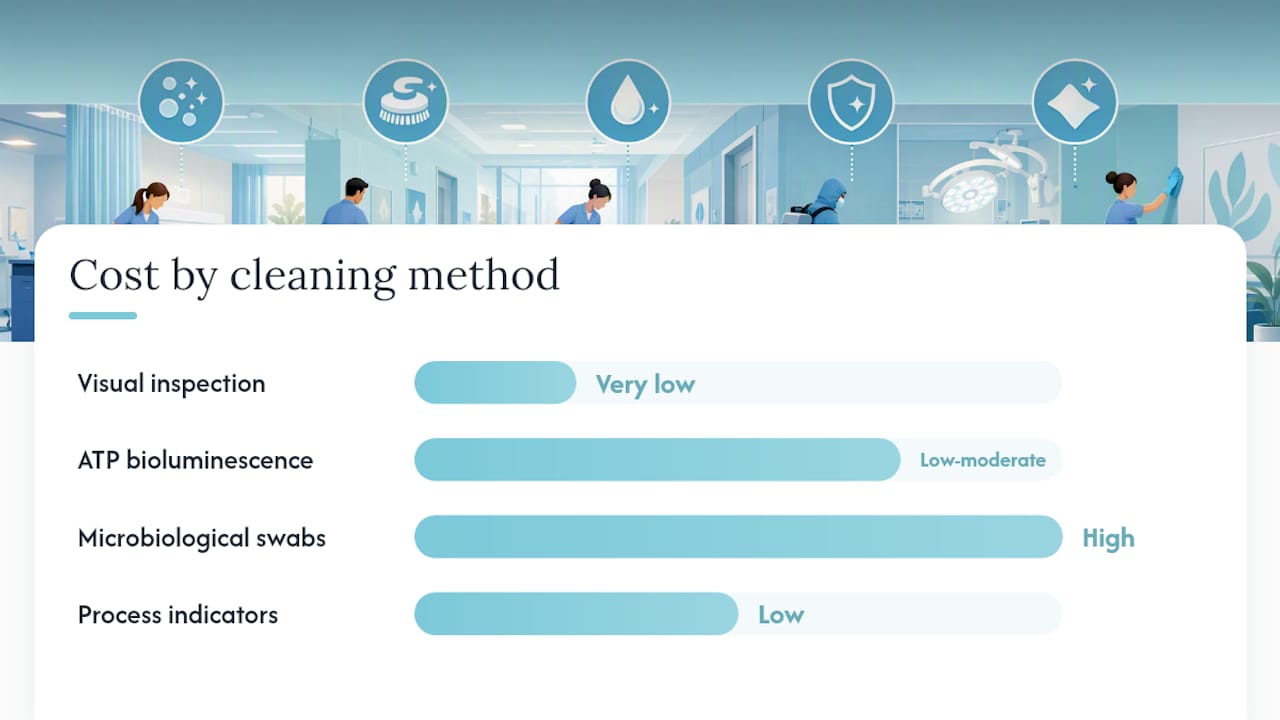
Visual inspection is the most common measure and the least sensitive. For high-risk areas, it needs to be supplemented.
ATP bioluminescence testing detects organic residue on surfaces quickly and without laboratory turnaround. Useful for routine monitoring and post-clean verification in theatres and critical care.
Microbiological swabs provide pathogen-specific data and are most appropriate during outbreak investigations or quality improvement projects rather than routine monitoring.
Process indicators (SOP adherence, colour-coding compliance, correct contact times) are captured during efficacy audits and are often the most revealing measure of systemic risk.
Method | Accuracy | Cost | Best use-case |
Visual inspection | Low-moderate | Very low | Routine monitoring, all areas |
ATP bioluminescence | Moderate-high | Low-moderate | Post-clean verification, high-risk areas |
Microbiological swabs | High | High | Outbreak investigation, quality improvement |
Process indicators | High (for process) | Low | Efficacy audits, training assessment |
Record all results against the specific area, date, and auditor. Link every failure directly to a corrective action in your rectification log. This chain of evidence is what demonstrates to external auditors that your programme is functioning, not just existing.
What records do you need to keep and what must you publish?
Good documentation is not administrative overhead. It is the evidence base that protects your trust during external audits and governance reviews.
Retain internally:
Audit schedules and completed audit scores (technical and efficacy) for each functional area.
Rectification logs with dates, responsible persons, and completion evidence.
Competency records for all cleaning staff, including induction and periodic reassessment dates.
Cleaning specifications per area, including any locally adjusted frequencies with documented rationale.
Signed Commitment to Cleanliness Charter.
Publish externally:
Star ratings from external audits, by area, in line with transparency requirements.
Summary results where required by commissioners or NHS England reporting frameworks.
A minimal record template for each functional area should capture: area name, FR category, specification code, last technical audit date and score, last efficacy audit date and outcome, outstanding rectification items, and next scheduled audit date. One row per area, reviewed monthly.
Common misconceptions and the red flags that signal deeper problems
The most persistent misconception is that cleaning compliance belongs to estates or domestic services. The 2025 standards are clear that it does not. Clinical teams own cleaning responsibilities within their zones, and audit scores reflect area outcomes, not the performance of any single team.
Red flags to watch for:
Recurrent efficacy failures in the same area across consecutive audits.
Rectification logs with open items older than 30 days and no escalation record.
Inconsistent or incorrect specification codes across similar room types.
Missing or outdated competency evidence for staff in FR category 1 or 2 areas.
Star ratings not published where external audits have been completed.
If you see two or more of these in a single area, treat it as a systemic failure requiring IPC and senior management involvement, not a scheduling adjustment.
Red flag | Likely root cause | First action |
Recurring efficacy failures | SOP not followed or not understood | Targeted retraining, SOP review |
Open rectification items | No escalation pathway | Assign named responsible person, set deadline |
Inconsistent spec codes | Initial mapping error | Re-audit FMT/NCSS mapping for affected areas |
Missing competency records | Records not maintained from outset | Audit training records, schedule reassessments |
Your audit-readiness checklist for the first month
Use this list in the first four weeks of any new implementation or compliance review.
Confirm FR category mapping is complete and documented for all clinical areas.
Verify the date of the last technical audit and last efficacy audit for each FR category 1 and 2 area.
Review rectification logs: are all items dated, assigned, and closed or escalated?
Check that training and competency records are current for all cleaning staff in high-risk areas.
Confirm FMT or NCSS specification codes are correctly assigned and audit schedules are active.
Verify that star ratings from the most recent external audit are published where required.
If any FR category 1 or 2 area has no recorded efficacy audit in the last three months, schedule one before any other audit activity.
Adapt this checklist to your trust’s size: a large acute trust may need a tiered approach by directorate; a smaller community setting can work through it as a single list.
Pro Tip: Run this checklist with your IPC lead present. The conversation it generates is often more valuable than the completed list itself, because it surfaces assumptions about who owns what that no document has ever captured.
Why the charter matters more than most trusts realise
Audits measure outcomes. The Commitment to Cleanliness Charter shapes the conditions that produce them. Signing the charter is a public statement that every member of staff, clinical and non-clinical, shares responsibility for a clean environment. That is not a soft aspiration. It is the mechanism by which cleaning standards move from a compliance exercise to a sustained cultural norm.
We have seen what happens when the charter is treated as a formality. Audit scores improve during inspection cycles and drift between them. The technical framework is sound, but without cultural ownership, it runs on compliance anxiety rather than genuine commitment. The teams that sustain high scores between external audits are the ones where ward managers, porters, and clinicians all understand that cleanliness is part of their role, not someone else’s.
The charter also matters for patient trust. Patients notice cleanliness. A visible, signed commitment displayed in clinical areas communicates that the organisation takes it seriously. That visibility is part of what the transparency principle in the 2025 standards is designed to achieve.
How Dudleyspecialistcleaners supports NHS trusts to meet cleaning standards
When your internal audit programme identifies a gap, whether a failed efficacy audit, an outbreak requiring deep decontamination, or a rectification timeline you cannot meet with in-house resource, an external specialist can close it quickly and with full documentation.
Dudleyspecialistcleaners provides hospital-grade disinfection services to NHS facilities, medical practices, and healthcare organisations across Dudley, Wolverhampton, and Walsall. Our work covers validated disinfection, efficacy-focused deep cleaning, mould remediation, and biohazard clearance, each completed with full documentation and certification to support your governance records. We can act as an impartial technical resource during rectification, supplying written evidence of the cleaning process that satisfies both internal audit requirements and external verification.
If your trust has high-risk areas with outstanding rectification items or an external audit approaching, request a quote or audit support directly from our team. We respond promptly and work to your timeline, not ours.
Sources
The documents below are the authoritative references for implementation. Each serves a specific part of the compliance process.
This article is general information, not a substitute for advice from a qualified doctor. Consult a qualified healthcare professional about your own circumstances before acting on anything here.
Recommended
Related Dudley services
For a booking, start with mould removal, after-death cleaning and house clearance. Call 07462 479 576 or 0800 193 3699.
Comments