Clinical waste disposal for NHS staff: HTM 07-01 checklist
- Simon D Campbell
- Aug 4
- 17 min read
Compliant clinical waste disposal in UK healthcare settings requires six immediate actions: segregate waste at the point of production using HTM 07-01 colour streams; use only authorised, licensed waste carriers; complete consignment notes for every collection; store waste in approved, labelled containers within a secure, locked area; use permitted treatment facilities; and retain all documentary evidence for audit. These duties flow directly from the Environmental Protection Act 1990, which establishes the Duty of Care framework, and from HTM 07-01, the NHS operational standard for healthcare waste segregation. The Environment Agency and the Health and Safety Executive share enforcement responsibility, and failures can result in prosecution, fines, and reputational damage to your organisation.
Here are the six actions to copy into your incident folder or handover sheet:
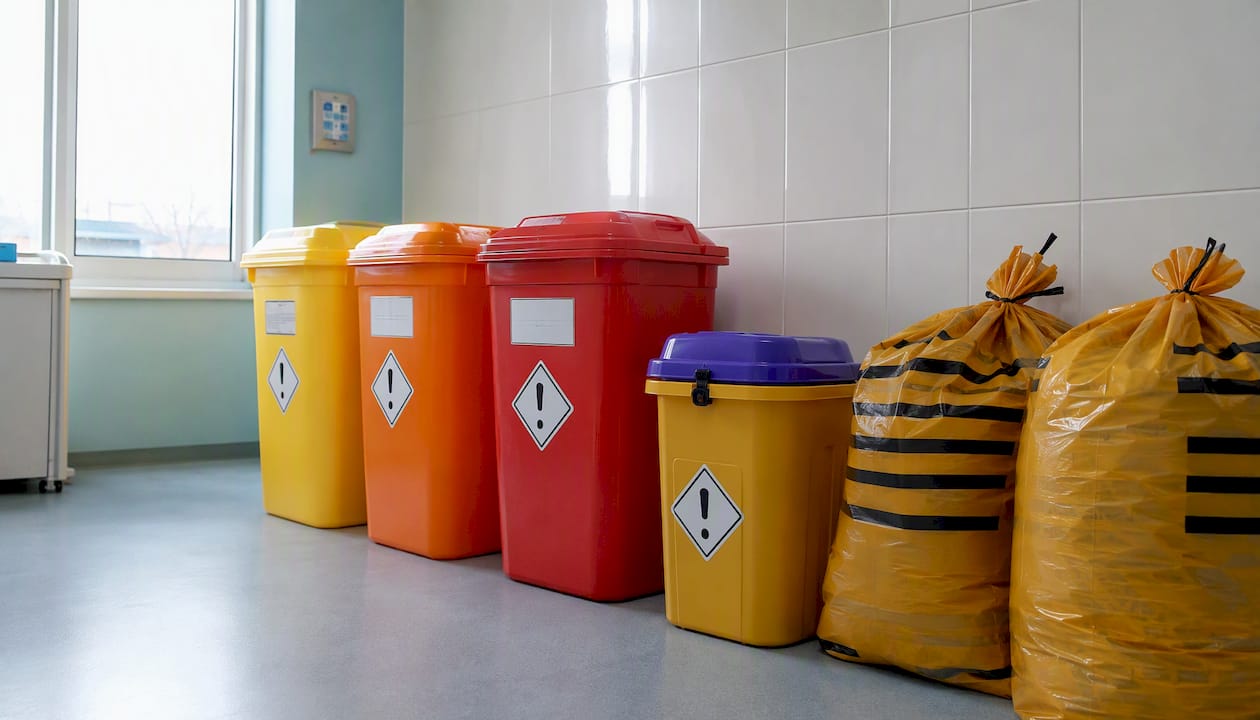
Segregate at source using HTM 07-01 colour-coded containers (yellow, orange, purple, red, tiger-stripe) at the point of care.
Verify your carrier holds a valid waste carrier registration before any collection takes place.
Complete a consignment note for every hazardous clinical waste collection, signed by both producer and carrier.
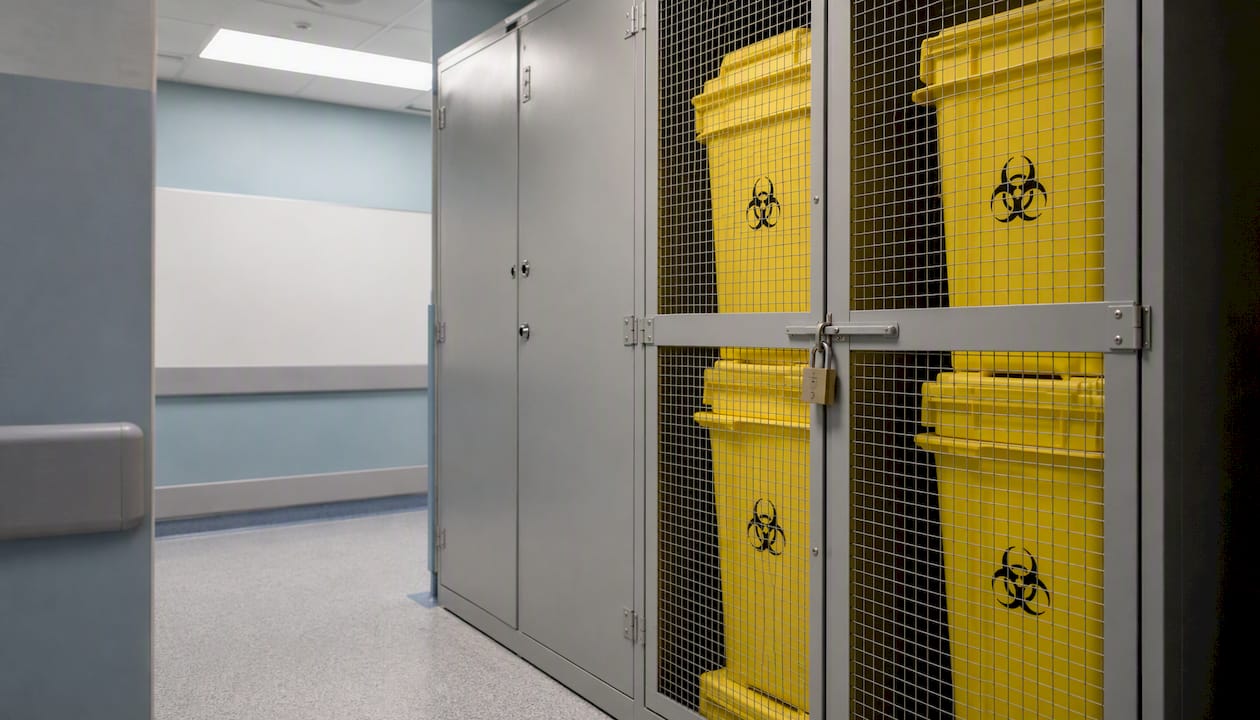
Store waste securely in a locked, weatherproof area with clear biohazard signage, away from public access.
Use only permitted treatment facilities that hold a valid environmental permit or exemption from the Environment Agency.
Retain all documents (consignment notes, certificates of safe destruction, training records) for a minimum of three years, or longer where required by local policy.
Pro Tip: The single most common audit failure is placing offensive (non-infectious) waste into yellow or orange clinical bags. Offensive waste belongs in tiger-stripe bags and follows a different, cheaper treatment route. Misclassification inflates costs and triggers Duty of Care breaches. Check this stream first.
Table of Contents
What are the key UK laws and enforcement bodies you must know?
How do you classify waste correctly and use the HTM 07-01 colour streams?
What are the approved containers, labelling rules and storage time limits?
How do you select a licensed carrier and complete consignment notes?
Which treatment routes are lawful and which wastes must go to incineration?
Day-to-day operations: segregation, training and sharps injury response
Audit-ready compliance checklist for inspections and handovers
How Dudleyspecialistcleaners handles clinical waste: process, certification and evidence
Balancing patient safety, NHS net-zero goals and legal compliance
Dudleyspecialistcleaners: clinical waste support across Dudley, Wolverhampton and Walsall
What are the key UK laws and enforcement bodies you must know?
The legal framework for medical waste management in the UK rests on several interlocking statutes and guidance documents. Together they define who is responsible, what is required, and who can prosecute when things go wrong.
Statute or guidance | What it requires | Who enforces it |
Duty of Care: producers must prevent harm and ensure lawful transfer and treatment of waste | Environment Agency (England); Natural Resources Wales; SEPA | |
Classifies clinical and offensive waste as household or commercial; sets charging rules for councils | Local authorities and Environment Agency | |
Hazardous Waste (England and Wales) Regulations | Requires consignment notes for hazardous waste; prohibits mixing hazardous and non-hazardous streams | Environment Agency |
HTM 07-01 (NHS England) | Operational segregation standard: colour streams, container types, storage and treatment routes for NHS settings | NHS England; CQC inspections; Environment Agency |
Strategic framework for NHS providers to improve waste management and align with HTM 07-01 | NHS England; Integrated Care Boards |
The Duty of Care is the central obligation. As a waste producer, you are legally responsible for your waste from the moment it is generated until it reaches a permitted treatment or disposal facility. That responsibility does not transfer simply by handing waste to a contractor. You must verify the contractor is authorised, complete the paperwork, and retain the evidence.
The Environment Agency holds primary enforcement responsibility in England, including issuing environmental permits to treatment facilities and maintaining the public register of waste carriers. The HSE focuses on the health and safety of workers handling healthcare waste, covering manual handling, sharps injury prevention, and infection control during collection and treatment. Both bodies can inspect premises and initiate prosecution independently.
Key obligations for waste producers:
Classify waste correctly before collection.
Use only licensed waste carriers registered with the Environment Agency.
Ensure waste reaches a facility holding a valid environmental permit.
Complete and retain consignment notes for hazardous clinical waste.
Provide written descriptions of waste to carriers (waste transfer notes for non-hazardous streams).
How do you classify waste correctly and use the HTM 07-01 colour streams?
HTM 07-01 translates legal waste categories into a colour-coded system that staff can apply at the point of care without needing to consult a waste code reference every time. Permitted treatment facilities can accept consignments on the basis of compliant colour-coded packaging, which means your segregation accuracy directly determines whether a collection is accepted or rejected at the gate.
The HTM 07-01 colour streams
Container colour | Contents | Required treatment |
Yellow bag | Highly infectious waste (confirmed infection risk) | High-temperature incineration only |
Orange bag | Infectious waste eligible for alternative treatment | High-temperature incineration or authorised alternative treatment |
Yellow rigid sharps bin | Sharps contaminated with medicines or cytotoxic agents | High-temperature incineration |
Purple lid sharps bin or purple bag | Cytotoxic and cytostatic waste (chemotherapy) | High-temperature incineration only |
Red bag or container | Anatomical waste (recognisable human tissue) | High-temperature incineration only |
Tiger-stripe (yellow/black) bag | Offensive/hygiene waste (non-infectious) | Permitted landfill or alternative treatment |
The difference between yellow and orange bags is one of the most frequently misunderstood points in clinical waste regulations. Yellow bags are reserved for waste that is, or is suspected to be, highly infectious. Orange bags cover infectious waste where the infection risk is lower and authorised alternative treatment (such as validated thermal or chemical disinfection) is acceptable. Cytotoxic and anatomical waste must always go to high-temperature incineration regardless of the container used, because no alternative treatment is validated to render these streams safe.
Classification decision flow
When staff are uncertain, apply this sequence: Does the item contain recognisable human tissue? If yes, use red. Does it contain cytotoxic or cytostatic medicines? If yes, use purple. Is it a sharp? Use the appropriate sharps bin (yellow rigid for medicine-contaminated, standard yellow rigid for non-medicine-contaminated). Is it infectious or potentially infectious? Use yellow or orange depending on the level of risk. Is it non-infectious hygiene waste with no contamination? Use tiger-stripe. If you remain unsure, treat it as infectious clinical waste and segregate accordingly. The cost of over-segregating is lower than the cost of a Duty of Care breach.
Do:
Segregate at the point of care, not at the collection point.
Use the correct container size and never overfill beyond the fill-line.
Label every container with the ward or site name and the date of first use.
Do not:
Place offensive waste (incontinence pads, nappies) in yellow or orange bags.
Mix pharmaceutical waste with infectious waste in the same container.
Use domestic bin bags for any clinical or offensive waste stream.
Transfer waste between containers once sealed.
What are the approved containers, labelling rules and storage time limits?
Choosing the right container is not simply a matter of colour. Each container must be fit for purpose, correctly labelled, and stored in conditions that protect staff, the public, and the environment until collection.
Labelling requirements
Every container must display, at minimum:
The name and address of the producing site (ward, practice, or facility).
The date the container was first used.
The waste type or stream (e.g. “infectious clinical waste” or “cytotoxic waste”).
The relevant waste code where required for hazardous waste consignment notes.
Storage requirements
Waste must be stored in a dedicated, locked area that is weatherproof, secure against unauthorised access, and clearly signed with biohazard warning notices. The storage area must be separate from clinical areas and inaccessible to the public. Refrigerated storage may be required for anatomical waste held for longer periods, depending on local policy and the volume involved.
Pro Tip: Sharps bins should be positioned at the point of use, at a height that allows safe one-handed closure, and never placed on the floor. A bin that is awkward to reach encourages unsafe practices and is a common finding in CQC inspections.
Maximum storage times are not universally fixed in statute, but HTM 07-01 and local environmental permit conditions typically set limits of:
Up to 72 hours for infectious clinical waste at ambient temperature in most settings.
Longer periods may be permitted under specific environmental permit conditions, but these must be documented and reviewed.
Anatomical waste held beyond short periods should be refrigerated or collected urgently.
When a collection is delayed beyond your permitted storage period, contact your licensed carrier immediately and document the escalation. Storing waste beyond permit conditions is itself a regulatory breach.
How do you select a licensed carrier and complete consignment notes?
The Duty of Care requires you to verify that any carrier you use is registered with the Environment Agency before a single collection takes place. Handing waste to an unregistered carrier is a criminal offence, regardless of whether the carrier appears professional or has collected from your site before.
Verifying carrier registration
Check the carrier’s registration on the Environment Agency’s public waste carriers register before engaging any new contractor and at each annual contract review. The register is publicly accessible and free to use. A carrier’s registration number should appear on their headed documentation and vehicles.
Carrier due diligence checklist
Before appointing a carrier, confirm:
Valid waste carrier registration (upper tier for clinical and hazardous waste).
Environmental permit or exemption held by the destination treatment facility.
Written confirmation of the permitted treatment route for each waste stream.
Adequate public liability and environmental liability insurance.
Signed waste transfer agreement or service contract.
Sample consignment note and certificate of safe destruction from a recent collection.
Consignment note requirements
For hazardous clinical waste (including infectious waste, cytotoxic waste, and sharps), a consignment note is legally required for every collection. The note must include:
Producer name, address, and contact details.
Carrier name, registration number, and vehicle details.
Receiving facility name, address, and permit number.
Description of the waste (waste code, physical form, quantity in kilograms or number of containers).
Date and time of collection.
Signatures of both the producer’s representative and the carrier’s driver.
Retain your copy of every consignment note. These documents are the primary evidence of lawful transfer in any Duty of Care audit or enforcement investigation.
Document | When required | Retention period |
Consignment note (hazardous waste) | Every hazardous clinical waste collection | Minimum 3 years |
Waste transfer note (non-hazardous) | Every non-hazardous collection | Minimum 2 years |
Carrier registration certificate | Before first collection; reviewed annually | Duration of contract plus 2 years |
Facility environmental permit | Before first collection; reviewed annually | Duration of contract plus 2 years |
Which treatment routes are lawful and which wastes must go to incineration?
The HSE states that effective healthcare waste management aims to render waste non-hazardous and inoffensive through controlled, validated processes. The two principal routes are high-temperature incineration and authorised alternative treatment (AAT), and the choice is not discretionary. The waste stream determines the treatment route.
Waste type | Acceptable treatment |
Highly infectious waste (yellow bag) | High-temperature incineration only |
Infectious waste (orange bag) | High-temperature incineration or authorised alternative treatment |
Cytotoxic/cytostatic waste (purple) | High-temperature incineration only |
Anatomical waste (red) | High-temperature incineration only |
Sharps (non-medicine-contaminated) | High-temperature incineration or authorised alternative treatment |
Offensive/hygiene waste (tiger-stripe) | Permitted landfill or alternative treatment |
Pharmaceutical waste (non-cytotoxic) | High-temperature incineration |
Authorised alternative treatments include validated thermal processes (such as autoclave or microwave disinfection) and chemical disinfection systems. To be lawful, these facilities must demonstrate that their process achieves a validated kill of the worst-case biological challenge load. Facilities cannot simply claim AAT status; they must hold an environmental permit that explicitly authorises the treatment method for the waste types they accept.
Before sending waste to an AAT facility, confirm in writing that the facility’s permit covers your specific waste stream. A facility permitted to treat orange-bag infectious waste is not automatically permitted to treat sharps or pharmaceutical waste. Misrouting waste to an unpermitted facility is a Duty of Care breach even if the carrier is registered.
Key points for procurement:
Request a copy of the facility’s environmental permit before signing a service contract.
Confirm the permit explicitly lists the waste codes you generate.
Ask for evidence of the facility’s most recent validation test results.
Obtain a certificate of safe destruction after each collection as proof of lawful treatment.
What records do you need to keep and for how long?
An incomplete audit trail is one of the most frequent compliance failures identified during Environment Agency and CQC inspections. Consignment notes, carrier evidence, and certificates of destruction must be organised and retained to prove lawful transfer and treatment at every stage.
Documents to retain
Service delivery notes from each collection.
Signed consignment notes (producer copy) for all hazardous waste collections.
Waste transfer notes for non-hazardous collections.
Certificates of safe destruction from the treatment facility.
Carrier registration certificates and facility environmental permits.
Staff training records (induction, refresher, and competency sign-offs).
Incident reports for sharps injuries, spills, and near-misses.
Waste acceptance records from the receiving facility.
Retention schedule
Document type | Minimum retention period |
Hazardous waste consignment notes | 3 years |
Non-hazardous waste transfer notes | 2 years |
Certificates of safe destruction | 3 years (or duration of contract) |
Staff training records | Duration of employment plus 3 years |
Incident reports | 3 years minimum; longer for sharps injuries involving bloodborne virus risk |
Carrier and facility permits | Duration of contract plus 2 years |
Audit evidence checklist
During an inspection, you should be able to produce, within minutes:
The most recent consignment note for each waste stream.
The carrier’s current registration certificate.
The treatment facility’s environmental permit.
The last three certificates of safe destruction.
Training records for all staff who handle or segregate clinical waste.
The most recent waste storage area inspection record.
Pro Tip: Create a shared digital folder named “Clinical Waste Compliance” with subfolders by year and document type. Name each file with the date and document type (e.g. “2025-11-14_ConsignmentNote_InfectiousWaste”). An auditor who can find every document in under two minutes is far less likely to escalate their inspection.
Day-to-day operations: segregation, training and sharps injury response
Regulation becomes meaningful only when it is embedded in daily practice. The steps below translate HTM 07-01 requirements into the operational routines that ward staff, community nurses, and practice managers can follow consistently.
Point-of-use segregation and transfer
Place the correct colour-coded container at the point of care before any procedure begins.
Dispose of waste immediately after use, directly into the appropriate container, without sorting or transferring between containers.
Apply the temporary closure mechanism on sharps bins after each use session.
When a bag or bin reaches the fill-line (never above it), apply the permanent seal and attach a completed label showing the ward, date, and waste type.
Transfer sealed containers to the designated internal collection point or directly to the secure external storage area, using a covered trolley where volumes require it.
Record the transfer in the ward waste log, noting the container type, quantity, and time.
Sharps injury response
If a sharps injury occurs:
Encourage the wound to bleed freely under running water. Do not suck the wound.
Wash thoroughly with soap and water; cover with a waterproof dressing.
Report immediately to the line manager and occupational health department.
Complete an incident report (Datix or equivalent system) within the same shift.
Seek clinical assessment for bloodborne virus risk (HIV, hepatitis B, hepatitis C) and follow the post-exposure prophylaxis protocol if indicated.
Retain the implicated sharp in a sealed container for investigation if safe to do so.
Spill response
Don appropriate PPE (gloves, apron, eye protection) before approaching the spill.
Contain the spill using absorbent granules or paper towels; place all contaminated material into a yellow clinical bag.
Decontaminate the area with an appropriate disinfectant (chlorine-releasing agent at 10,000 ppm for blood spills).
Complete an incident report and review the root cause to prevent recurrence.
Staff training matrix
Training topic | Delivery method | Frequency | Record to keep |
Clinical waste segregation (HTM 07-01) | Induction and annual refresher | On joining; annually | Signed attendance sheet |
Sharps safety and injury response | Induction and practical demonstration | On joining; annually | Competency sign-off |
Spill management | Induction | On joining; after any incident | Signed attendance sheet |
Consignment note completion | On-the-job training | On joining; when procedures change | Training record |
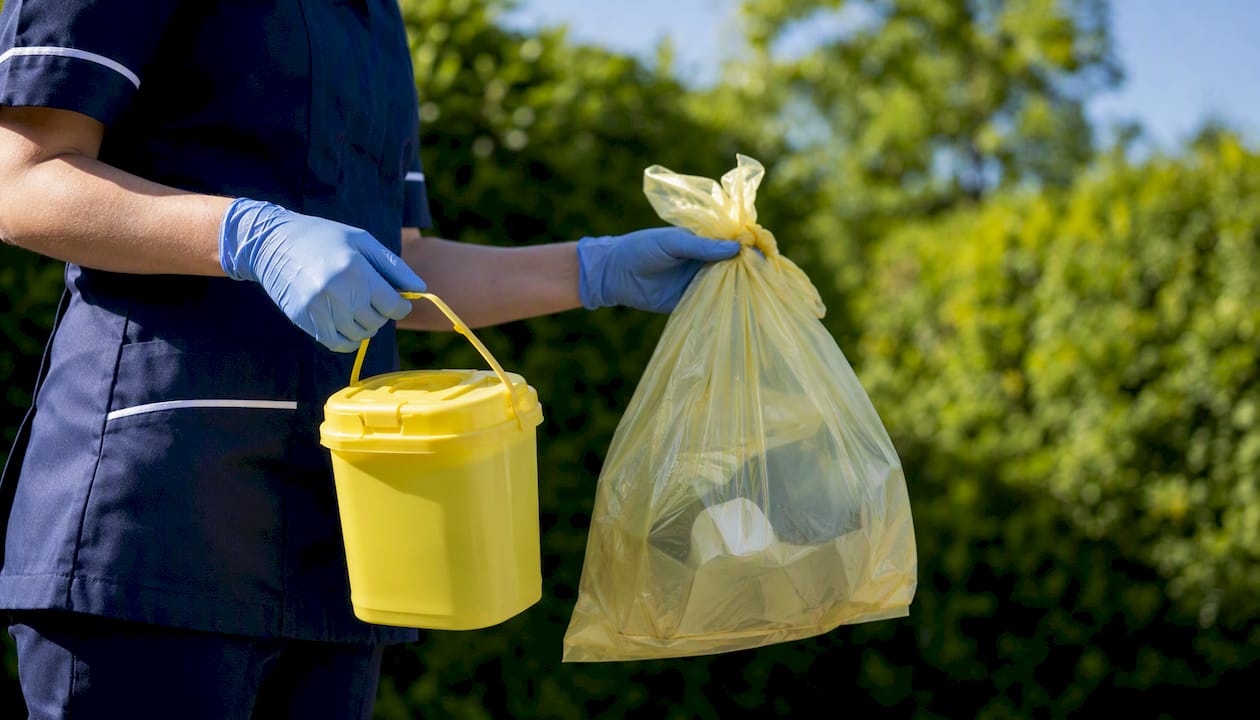
Community nurses and domiciliary workers should carry a portable sharps bin and a sealable clinical waste bag on every visit. Waste generated during a home visit is commercial clinical waste and must be returned to the base clinic for collection by a licensed carrier. It must not be left with the patient or placed in household bins.
When do councils collect domestic clinical waste?
The boundary between household and commercial clinical waste is set by the Controlled Waste (England and Wales) Regulations 2012. Waste generated by a patient self-managing a condition at home (for example, insulin-dependent diabetics disposing of used lancets) may be treated as household waste, meaning the local council has a duty to collect it, though charges and service conditions vary.
The GOV.UK clinical waste collection portal allows individuals to request a collection from their local council. Typical exclusions include large volumes of pharmaceutical waste, cytotoxic agents, and anatomical material, which councils are not equipped to handle and which require a licensed contractor regardless of the setting.
Advice for community health staff and social care teams:
Advise patients who self-inject or self-test to contact their local council for a free or subsidised sharps collection bin.
Confirm with the council whether the service covers the specific waste type before advising the patient.
Where a council service is unavailable or unsuitable, direct patients to a licensed contractor or a pharmacy sharps return scheme.
Waste generated by a community nurse during a home visit is always commercial clinical waste and must be removed by the nurse, not left with the patient.
Document the advice given to patients regarding safe disposal as part of the care record.
For house clearances involving clinical or offensive waste, particularly in properties where a vulnerable person has been living, the waste is typically commercial and requires a licensed contractor rather than a council collection.
What drives the cost of clinical waste collection?
Cost is rarely a single figure. Several variables interact to produce the final price for any clinical waste service, and understanding them helps you specify contracts accurately and avoid unexpected charges.
Factors that drive cost:
Waste type: cytotoxic and anatomical waste require high-temperature incineration, which carries a higher gate fee than authorised alternative treatment for orange-bag infectious waste.
Container type and weight: rigid sharps bins and cytotoxic containers are heavier and more expensive to transport than bagged waste.
Collection frequency: ad hoc or urgent collections typically carry a premium over scheduled weekly or fortnightly rounds.
Distance to the permitted facility: longer transport distances increase fuel and haulage costs, particularly for specialist incineration facilities.
Volume and segregation quality: well-segregated waste is cheaper to process because facilities can accept it on the basis of colour coding alone, without manual inspection.
Documentation requirements: services that include certificates of safe destruction and consignment note management may carry a slightly higher service fee but reduce your internal administration burden.
Misclassification consistently increases costs. Placing offensive waste into yellow clinical bags sends non-infectious material to high-temperature incineration at a higher gate fee than necessary. Correct segregation of tiger-stripe offensive waste from clinical streams is one of the most straightforward ways to reduce disposal expenditure without compromising compliance.
When requesting quotes from suppliers, ask for:
A breakdown of costs by waste code and container type.
Confirmation of the permitted treatment facility and its environmental permit number.
A sample consignment note and certificate of safe destruction.
The proposed collection frequency and escalation process for urgent collections.
Clarity on whether the price includes documentation and audit support.
For GP practices, the typical collection frequency is fortnightly for sharps and monthly for bagged infectious waste, though this varies with patient volume. Larger NHS ward settings may require weekly or twice-weekly collections.
Audit-ready compliance checklist for inspections and handovers
Use this checklist during a CQC inspection, an Environment Agency visit, or a shift handover to demonstrate Duty of Care and HTM 07-01 compliance. The responsible person should sign and date the checklist at each review.
Segregation and containers:
[ ] All waste segregated at point of care using correct HTM 07-01 colour stream.
[ ] No offensive waste in yellow or orange clinical bags.
[ ] Sharps bins at point of use, not overfilled, temporary closure applied between sessions.
[ ] All sealed containers labelled with site name, date, and waste type.
[ ] No unsealed or unlabelled containers in storage.
Storage area:
[ ] Storage area locked and access restricted to authorised staff.
[ ] Biohazard signage clearly visible.
[ ] Waste within permitted storage time limits.
[ ] Separate bays or areas for different waste streams.
[ ] No waste stored in clinical or public areas.
Carrier and documentation:
[ ] Current carrier registration certificate on file.
[ ] Treatment facility environmental permit on file.
[ ] Signed consignment notes retained for all hazardous collections.
[ ] Certificates of safe destruction received and filed for the last three collections.
[ ] Waste transfer notes retained for non-hazardous collections.
Training and incidents:
[ ] Training records current for all staff who handle clinical waste.
[ ] Incident log reviewed and up to date.
[ ] Sharps injury protocol displayed in clinical areas.
Sign-off:
Responsible person: ______________________ Date: ____________ Next review: ____________
During a sudden inspection, present this checklist alongside your most recent consignment note and the carrier’s registration certificate. These three items answer the majority of an inspector’s opening questions and demonstrate that your system is managed, not reactive.
How Dudleyspecialistcleaners handles clinical waste: process, certification and evidence
Dudleyspecialistcleaners works with NHS facilities, GP practices, care homes, and residential clients across Dudley, Wolverhampton, and Walsall to manage clinical and biohazard waste from the point of generation through to evidenced, lawful destruction. Our process is designed to give you a complete audit trail without adding administrative burden to your team.
Our service process:
Site assessment: we review your waste streams, volumes, and storage arrangements before any collection begins, identifying any segregation gaps or documentation shortfalls.
Collection and transfer: waste is collected by authorised personnel using appropriate PPE and transferred to a licensed carrier holding a valid upper-tier waste carrier registration.
Treatment: waste is directed to a permitted treatment facility appropriate to the waste stream (high-temperature incineration for cytotoxic, anatomical, and highly infectious waste; authorised alternative treatment where validated and permitted).
Documentation: we provide a service delivery note, a copy of the signed consignment note, and a certificate of safe destruction after every collection.
Documents provided to contracting organisations:
Service delivery note (collection date, waste type, container count, and weight).
Signed consignment note (producer and carrier copies).
Certificate of safe destruction from the treatment facility.
Carrier registration certificate and facility environmental permit (on request).
Risk assessment summary for the collection process.
Our hospital-grade disinfection services extend to decontamination of clinical areas following waste removal, including after-death cleaning, trauma scene decontamination, and infection control deep cleans. We also handle after-death cleaning in Walsall and complex clearances where clinical and anatomical waste may be present alongside general household items, providing the documentation that contracting organisations and coroners’ services require.
Key takeaways
Compliant clinical waste disposal in UK healthcare settings requires correct segregation at source, licensed carriers, consignment notes, permitted treatment facilities, and a complete, retained audit trail.
Point | Details |
Segregate at source using HTM 07-01 | Use the correct colour stream at the point of care; offensive waste in tiger-stripe bags, not yellow or orange. |
Verify carriers and facilities | Check the Environment Agency waste carriers register before every new appointment and at each annual review. |
Complete and retain consignment notes | Hazardous clinical waste consignment notes must be retained for a minimum of three years as legal proof of lawful disposal. |
Maintain a complete audit trail | Keep consignment notes, certificates of safe destruction, training records, and incident logs organised and immediately retrievable. |
Dudleyspecialistcleaners | Provides collections, licensed transfer, certificates of safe destruction, and full documentation for NHS and residential clients across Dudley, Wolverhampton, and Walsall. |
Balancing patient safety, NHS net-zero goals and legal compliance
There is a genuine tension at the heart of NHS waste policy that does not get enough honest attention. The NHS net-zero ambitions, set out in the NHS Long Term Plan and reinforced by NHS England’s sustainability agenda, push towards reducing incineration and increasing the use of authorised alternative treatments. That is a reasonable objective. High-temperature incineration is energy-intensive and carries a carbon cost. But the pressure to reduce incineration can, if applied without care, lead procurement teams to route waste to AAT facilities that are not validated for the specific streams they are accepting.
The regulatory framework is clear: cytotoxic, anatomical, and highly infectious waste must go to high-temperature incineration. There is no validated alternative for these streams, and no sustainability argument overrides that requirement. Where AAT is genuinely appropriate, for orange-bag infectious waste and non-medicine-contaminated sharps, it is both compliant and environmentally preferable. The problem arises when cost pressure or sustainability targets encourage misclassification, pushing waste into orange bags when it should be yellow, or into AAT facilities that lack the correct permit.
The most practical contribution any NHS facility can make to both sustainability and compliance is accurate segregation. Keeping offensive waste out of the clinical stream reduces the volume sent to incineration, lowers costs, and reduces carbon output, all without touching a single regulatory boundary. Investing in staff training and segregation audits delivers more measurable environmental benefit than any procurement shortcut.
Legal compliance and patient safety are not obstacles to sustainability. They are the floor below which no efficiency argument applies.
Dudleyspecialistcleaners: clinical waste support across Dudley, Wolverhampton and Walsall
When your facility needs clinical waste collections backed by complete documentation, Dudleyspecialistcleaners offers a straightforward alternative to managing multiple contractors and chasing paperwork. We handle the collection, licensed transfer, and evidenced treatment of clinical and biohazard waste for NHS facilities, GP practices, care homes, and residential clients across Dudley, Wolverhampton, and Walsall. Every collection comes with a signed consignment note, a service delivery note, and a certificate of safe destruction, giving you the audit trail you need without the administrative overhead.
Our team also provides decontamination and deep cleaning of clinical areas following waste removal, sharps injury scene management, and infection control support for settings that need more than a collection service. For complex situations including trauma scenes, after-death clearances, or hoarder property clearances where clinical waste may be mixed with general household items, we assess, segregate, and document every stream correctly.
To request a quote or arrange a compliance site assessment, contact us through our specialist cleaning services page. We respond to all enquiries promptly and can arrange an initial site visit at a time that suits your team.
Useful sources and further reading
The sources below are the primary references for UK clinical waste compliance. Each is maintained by a government body or statutory authority and should be your first point of reference for any regulatory question.
This article provides general guidance on UK clinical waste regulations and is not a substitute for legal or professional advice. Always confirm current requirements with the Environment Agency, HSE, or a qualified waste management professional for your specific circumstances.
Recommended
Comments